
Many interior design projects begin with rendering software, which has the power to transform the designer’s visions into realistic 3D visualizations.
However, with so many available options, choosing the best software can be a challenge for interior designers. And with the number of high-quality rendering programs continuously increasing, the decision has become even more overwhelming.
In some cases, all you need are easy-to-use drawing tools, a good template library, and lighting features. Other times, you might require a more complex rendering system with capabilities for collaboration, sculpting, and animation.
So, which software is best for the needs of your interior design business? Whether you’re a solo designer just starting out seeking a decent free rendering software or a founder of a large firm willing to invest in a more sophisticated rendering program, there are plenty of available options. Many user-friendly rendering software choices are either free or available for a small fee, and for more advanced needs, higher-priced options offer more complex features.
Many rendering programs are made for specific platforms such as Windows or MacOS, so it’s important to factor in whether an online program, an app, or downloadable software is best suited to your resources.
We’ve sifted through the rendering software reviews and put together a list of the best options on the market. While some of these programs have been developing for decades, there are also new and emerging companies breaking into the industry, each offering something unique.
Table of Contents
Rendering software platform comparison
Here’s a quick glance at the top tools, what they offer, and who they’re built for.
| Platform Focus | Intended Audience | |
| DesignFiles | Interior-focused rendering with full workflow | Interior designers, decorators, e-designers |
| D5 Render | Real-time ray tracing and animation | Interior designers, architects, landscapers, 3D artists |
| Blender | Open-source 3D modeling and rendering | Designers, VFX artists, animators, architects |
| Lumion | High-quality real-time rendering | Interior designers, architects, 3D designers |
| ZBrush | Sculpting and photoreal 3D rendering | Creative professionals, 3D artists |
| Planner 5D | Simple rendering for space planning | Interior designers, home decorators |
| 3ds Max Design | Complex modeling with high-end rendering | Architects, VFX artists, 3D designers |
| Cinema 4D | Industry-grade 3D modeling and animation | Creative professionals, motion designers |
| KeyShot | Real-time rendering for products and interiors | Industrial designers, marketers, interior designers |
| SketchUp | Precise 3D modeling with rendering support | Interior designers, architects |
| Foyr Neo | Interior design with rendering & floor plans | Interior designers, firms, students |
| Enscape | CAD-integrated real-time visualization | Architects, interior designers, engineers |
| HomeVisualizer.ai | Fast photo-to-render transformations | Architects, interior designers, engineers |
| ArchiVinci | Image-to-render for interiors and masterplans | Architects, designers, real estate professionals |
| Interior AI | Instant room redesigns and virtual staging | Interior designers, realtors, homeowners, architects |
Rendering software pricing comparison
Now, let’s compare the platforms pricing and ratings.
| Free Plan | Pricing Range | Ratings | |
| DesignFiles | ✅Free for up to one project | $49 – Custom | 4.6 on Capterra, 4.5 on G2 |
| D5 Render | ✅ | $0 – $59/month | 4.8 on Capterra, 4.8 on G2 |
| Blender | ✅ | $0 – $11.50/month | 4.7 on Capterra, 4.6 on G2 |
| Lumion | ❌ | $62 – $125/month | 4.7 on Capterra, 4.4 on G2 |
| ZBrush | ❌ | $39 – $895 | 4.7 on Capterra, 4.7 on G2 |
| Planner 5D | ✅ | $0 – Varies | 4.5 on Capterra, 4.7 on G2 |
| 3ds Max Design | ❌ | $215/month | 4.6 on Capterra, 4.3 on G2 |
| Cinema 4D | ✅ | $140/month – $999/yr | 4.6 on Capterra, 4.6 on G2 |
| KeyShot | ❌ | $29 – $99/month | 4.7 on Capterra, 4.5 on G2 |
| SketchUp | ❌ | $119 – $749/year | 4.5 on Capterra, 4.5 on G2 |
| Foyr Neo | ✅ | $39 – $159/month | 4.0 on Capterra |
| Enscape | ✅ | $47 – $94/month | 4.4 on Capterra, 4.6 on G2 |
| HomeVisualizer.ai | ❌ | $12 – $75/month | Not publicly rated |
| ArchiVinci | ❌ | $39 – $699/year | 4.0 on Trustpilot |
| Interior AI | ✅ | $29 – $99/month | 4.6 on G2 |
15 best rendering software
These rendering programs are our top choices.
1. DesignFiles
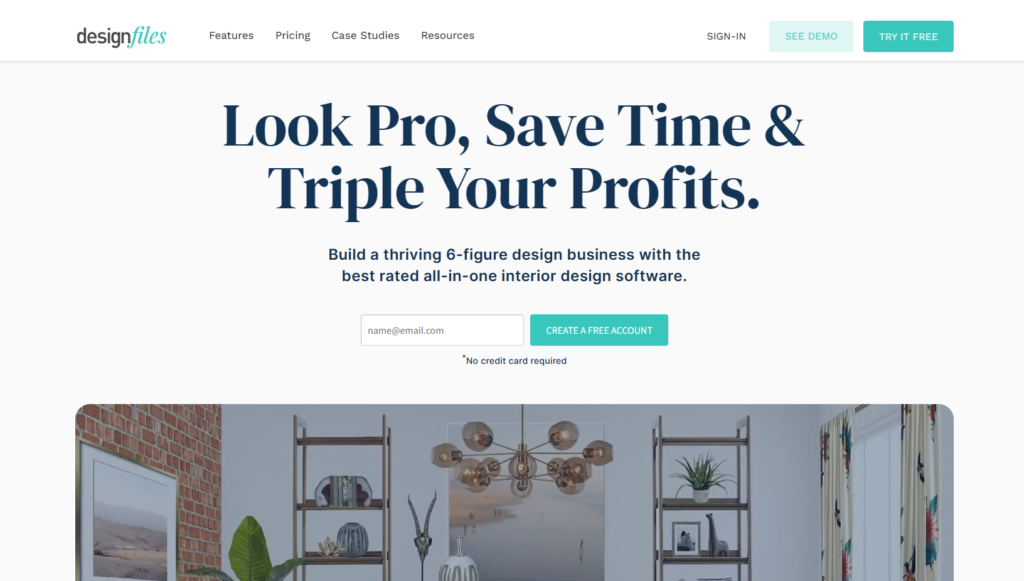
DesignFiles is a professional-grade, all-in-one platform built exclusively for interior designers. It includes everything from moodboards and 3D floor planning to invoicing, product sourcing, and client collaboration tools. Recently, DesignFiles added an AI enhancement tool that transforms moodboards and 3D mockups into photorealistic visuals, directly inside the platform. No exporting, extra apps, or learning curves required.
Built for: Interior designers, decorators, and e-designers who want to manage their full design workflow in one place.
Features:
- Drag-and-drop moodboard editor with AI image enhancement
- 3D floor planner with built-in product and materials library
- AI-enhanced renders for both moodboards and 3D mockups
- Product clipper browser extension for easy sourcing
- Branded spec sheets, tear sheets, and PDF exports
- Centralized client portal for design feedback and payments
- Task dashboard with smart follow-ups and reminders
- Full financial toolkit with invoices, payments, and QuickBooks integration
- Unlimited projects and clients on all paid plans
- Extensive library of templates (design questionnaires, contracts, presentations, and more)
Pros and Cons:
DesignFiles is a powerful all-in-one platform tailored specifically for interior designers, offering built-in AI enhancement for both moodboards and 3D mockups. It’s perfect for managing the full client workflow in one place. However, it’s not designed for architects or contractors, and doesn’t support architectural modeling or structural design tasks.
Pricing:
DesignFiles offers a free plan for one project so you can try the platform before committing. Paid plans start at $49/month, with the Full Service plan at $69/month, and custom pricing available for larger teams. Additional users are $25/month. Every account includes free AI credits, and AI rendering enhancements cost just $0.01 per image credit.
Reviews: Design Files has an average rating of 4.6 (out of 534 reviews) on Capterra and 4.5 (out of 5 reviews) on G2.
Platform: Web-based (accessible on both Windows and Mac with no download required)
2. D5 Render
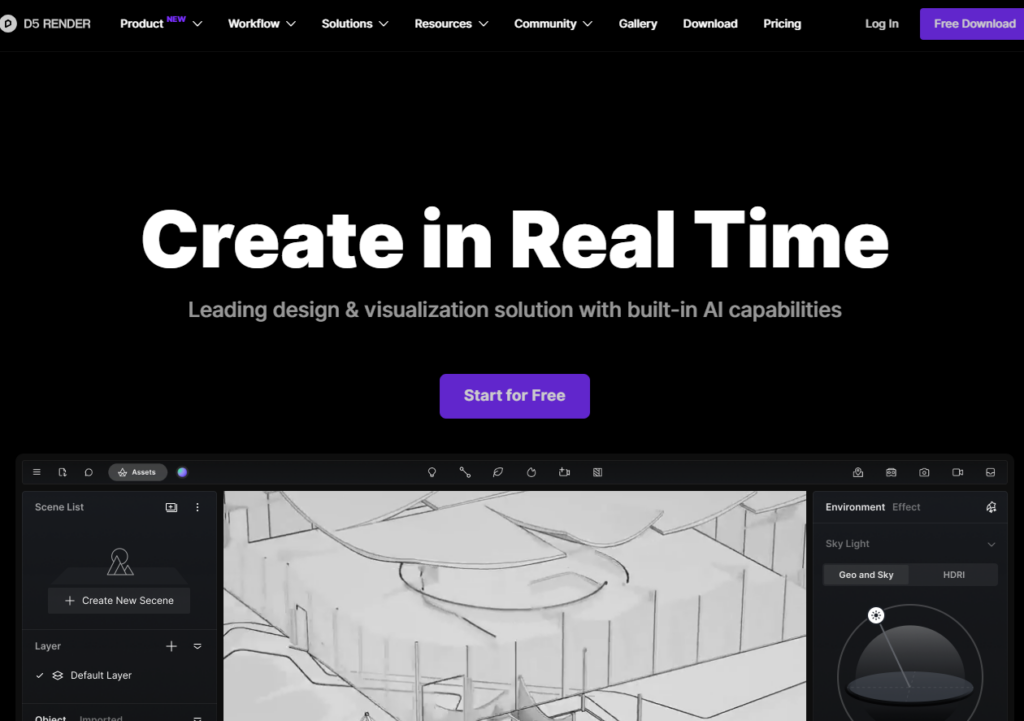
D5 Render is a real-time ray-tracing software for interior design, architecture, 3D, and landscape design, enabling the creation of photorealistic images and VR experiences. It’s compatible with most major design software platforms and offers intuitive UI, powerful features like AI Atmosphere Match, and abundant assets.
Built for: Interior designers, architects, landscapers, engineers, and other 3D professionals.
Features:
- D5 GI solution
- Real-time ray tracing
- Large scene capability
- High-res images/panoramas up to 16k
- 4k video rendering
- Virtual reality and animation
- D5 SR image rendering
- AI capabilities include AI-generated material texture maps, atmosphere match, ultra HD texture, and text to 3D.
- Collaboration tools
- Content and component library
Pros and Cons:
D5 Render stands out for its intuitive real-time ray tracing, gorgeous lighting presets, and drag-and-drop AI Atmosphere Match that replicates natural scenes in seconds. Its high-quality visuals, ease of use, and smooth integration with tools like Revit and SketchUp make it ideal for architects. However, light behavior in day/night scenes requires manual tweaking, which slows down workflows.
Pricing: D5 Render has a free version designed for beginners and individuals. It offers a pro plan for $30 per month and a team version for $59 per month.
Reviews: D5 Render has an average rating of 4.8 (out of 365 reviews) on Capterra and 4.8 (out of 988 reviews) on G2.
Platform: Windows
3. Blender
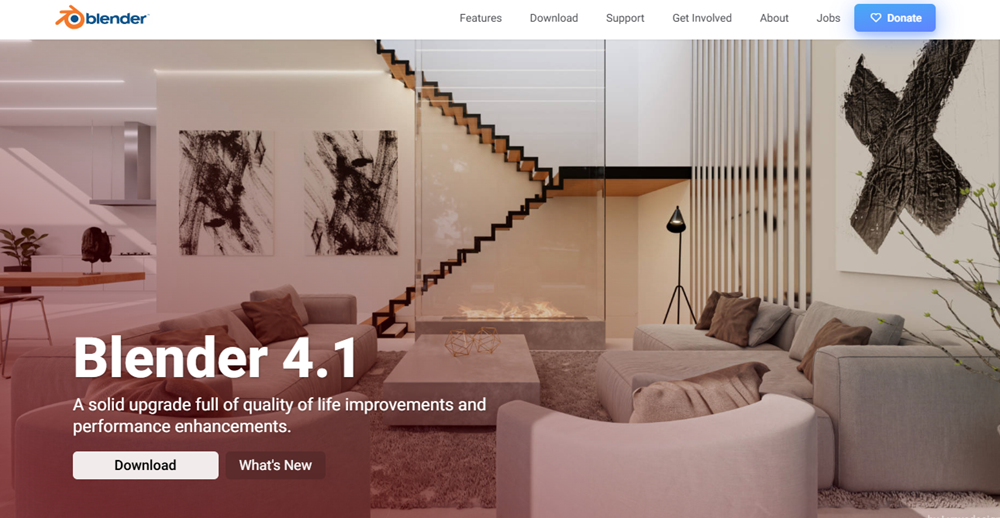
Blender is a free program that contains everything from modeling, rigging, animation, and simulation to rendering, compositing, and motion tracking. It even has video editing and game creation features. However, it’s more complex than other rendering software and can be overwhelming for interior designers focused on practical design tasks.
Built for: Interior designers, 3D artists, animators, filmmakers, designers, VFX studios, game developers, and architects.
Features:
- Cycles render engine
- Sculpting and modeling tools
- Effects
- Topology
- Template library
- File editing, video editing
- Downloadable application
- Character animation tools like rigging and skinning
- Node-based compositor
- Phyton scripting for custom tools and add-ons
Pros and Cons:
Blender is free, powerful, and packed with tools for modeling, animation, rendering, and more. Its Cycles engine delivers high-quality visuals, and the open-source community keeps it constantly evolving. That said, the interface is dense and can overwhelm beginners. It’s best for tech-savvy designers or studios with time to invest in learning the full feature set.
Pricing: Blender is completely free to download and use. You have access to all tools and resources because Blender is defined by its General Public license. You can also purchase the studio subscription for $11.50.
Reviews: Blender has an average rating of 4.7 (out of 948 reviews) on Capterra and 4.6 (out of 307 reviews) on G2.
Platform: Windows, MacOS, Linux
4. Lumion
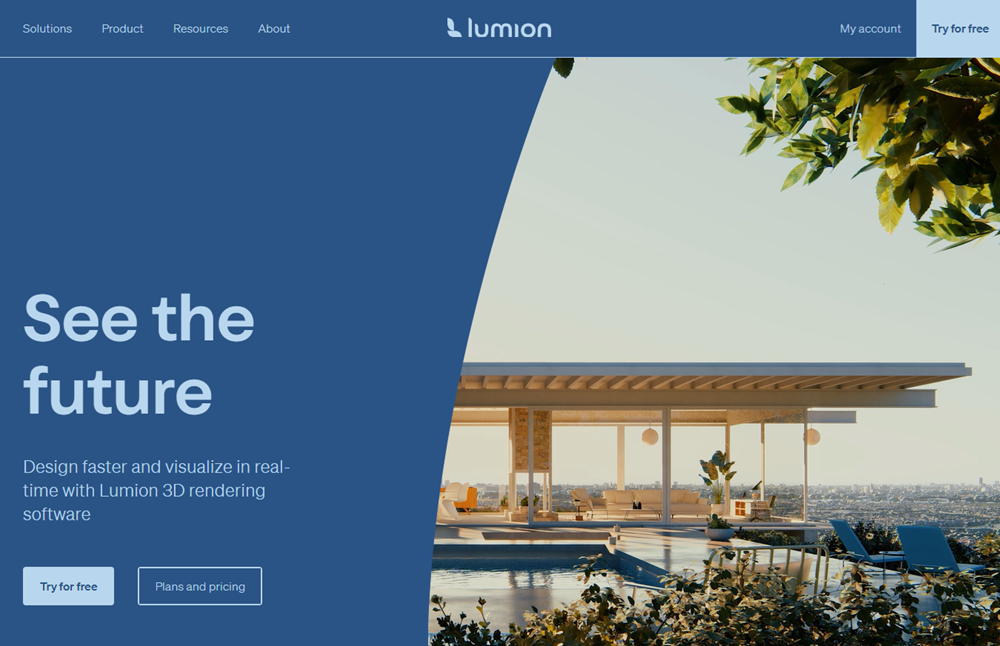
Due to its ease of use and simple layout, Lumion is a great option for interior designers who require a quick, high-quality output. However, a device with high performance such as the RTX 4090 Laptop GPU or equivalent with 10GB+ and at least Windows 10 is recommended. It’s not best suited for Macs and other operating system users.
Built for: Interior designers, architects, and 3d designers.
Features:
- Textures and shading
- Exterior rendering
- Aerial rendering
- Lighting
- Atmospheric rendering
- Documentation
- Sequence
- Collaboration
- 3D rendering and 3D rendering integration
- Library including objects and materials
Pros and Cons:
Lumion is loved for its speed and ease of use, making it simple to produce polished, client-ready renders in a short amount of time. The built-in asset library and lighting tools are great for quick visual storytelling. On the downside, it’s resource-heavy, Windows-only, and can get expensive, especially when upgrading to newer versions.
Pricing: Lumion offers a standard package for $62.42 per month and a pro version for $124.92. Both packages include one month for free.
Reviews: Lumion has an average rating of 4.7 (out of 156 reviews) on Capterra and 4.4 (out of 89 reviews) on G2.
Platform: Windows PCs
5. ZBrush

As a creative designer, you will probably love ZBrush. The software includes a wide range of tools and features including some of the best shape and sculpting tools. It also includes various polygons that allow users to sculpt organic and hard surfaces. However, its initial interface may overwhelm beginners and it can take some time to get the hang of it.
Built for: All creative professionals
Features:
- Photoreal rendering
- Wide selection of Plugins
- Suitable for 3D printing
- Non-linear design
- 3D fibers
- Transparent Subtools
- Map generation
- LightCap system
- Custom materials
- 3D sculpting
Pros and Cons:
It shines when it comes to detailed, organic sculpting and creative freedom, making it a favorite for artists working on characters, objects, and complex forms. The toolset is incredibly powerful, but the interface can feel dense and intimidating at first. It’s not the best all‑in‑one renderer, and the learning curve (and price) may be steep for beginners.
Pricing: ZBrush has five different pricing options, ranging from $39.95 to $895.
Reviews: ZBrush has an average rating of 4.7 (out of 36 reviews) on Capterra and 4.7 (out of 101 reviews) on G2.
Platform: Windows, macOS
6. Planner 5D
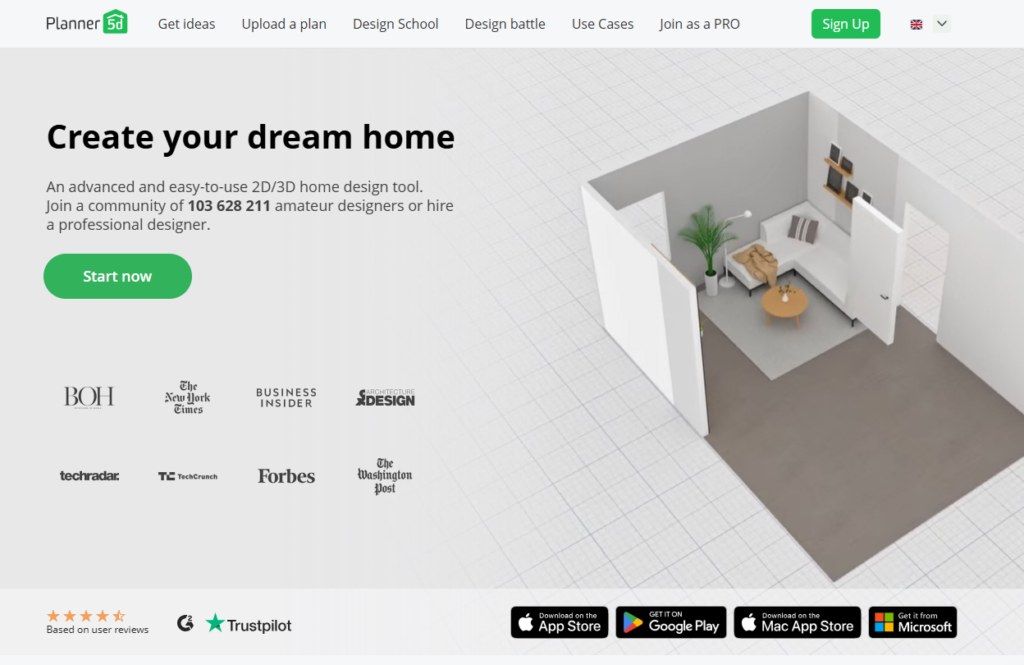
Planner 5D includes an impressive amount of textures, styles, and customization. However, its lack of advanced features makes it best for beginning interior designers. There have also been reports of occasional glitches and the web version can slow down your computer.
Built for: Interior designers and home decorators
Features:
- 2D drawing
- 3D imaging
- Building
- Activity dashboard
- Building information model
- Data import/export
- Customizable templates
- Data visualization
- Design management
- Degree visualizer
Pros and Cons:
Planner 5D is super beginner-friendly, with a drag-and-drop interface that makes creating floor plans and 3D visuals easy, even for non-designers. It’s great for testing ideas quickly, but lacks advanced tools for professional-level design. Some users have reported glitches, slow performance on web, and tricky cancellation policies that could be frustrating for casual users.
Pricing: There are Basic and Premium plans available on Planner 5D. The Basic plan is free but with limitations. If you want access to the full catalog, different payment options can depend on your platform or region. There is a three-day trial with iOS and MacOS platforms.
Reviews: Planner 5D has an average rating of 4.5 (out of 117 reviews) on Capterra and 4.7 (out of 152 reviews) on G2.
Platform: Web, IOS, Android, macOS, Windows, VisionOS
7. 3ds Max Design
3ds Max Design is a comprehensive 3D design, modeling, animation, and rendering software developed by Autodesk Media and Entertainment, it can create complex 3D models and is recommended for high-end renders. However, it’s a powerful software, is expensive, and has a steep learning curve.
Built for: Any creative professional
Features:
- 3Drendering
- Integrated Arnold renderer
- Retopology tools
- Interactive viewports
- Multiple file format support
- Interactive viewports
- Smart Extrude
- Texturing and shading
- Animation and effects including motion paths and character animation tools
- Modern UI and workspaces
- Extensive plug-in library
Pros and Cons:
With a massive toolkit for modeling, rendering, and animation, 3ds Max is a go-to for professionals who need high-end, photoreal results. It’s incredibly powerful, but definitely not plug-and-play—expect a steep learning curve and a hefty price tag. Ideal for experts, but overwhelming for beginners or designers who need quick, simple outputs.
Pricing: 3ds Max starts at $215 per month with yearly discounts available.
Reviews: 3ds Max has an average rating of 4.6 (out of 111 reviews) on Capterra and 4.3 (out of 277 reviews) on G2.
Platform: Windows
8. Cinema 4D
Due to its easy-to-use style, designers can create complex 3D graphic models using Maxon’s Cinema 4D. It features advanced UV mapping, placement tools, scene manager, and Redshift rendering which makes it an industry-leading 3D software. However, due to its price point, it’s difficult for individual or beginner designers to access.
Built for: Any creative professional
Features:
- 3D modeling
- Animation
- Building information model
- Design management
- Image editing
- Content library
- 2D drawing
- Video content
- Drag & drop
- Templates
Pros and Cons:
Loved for its intuitive design and motion graphics tools, Cinema 4D is a favorite among creatives who want power and ease of use. It’s beginner-friendly compared to other pro tools, but the price tag can be steep. Redshift rendering is a standout, though you’ll need a capable machine to keep things running smoothly.
Pricing: Cinema 4D offers a 14-day free trial for new users, after which the software is available from $999 per year / $140 per month.
Reviews: Cinema 4D has an average rating of 4.6 (out of 71 reviews) on Capterra and 4.6 (out of 135 reviews) on G2.
Platform: Windows, MacOS, Linux
9. KeyShot
KeyShot is a real-time render engine popular in the design industry for its ease of use, compatibility with CAD data, and accurate material appearance. However, it’s more of an expensive option compared to other rendering softwares with little added benefit.
Built for: Industrial designers, interior designers, graphic designers, engineers, CG specialists, photographers, and marketing professionals.
Features:
- Real-time speed
- Easy to make rendering changes
- CPU powered
- Accurate materials
- Advanced lighting
- Efficient workflow
- Animation
- CMF
- Physics simulation
- Web viewer
Pros and Cons:
Known for its simple workflow and accurate materials, this tool makes it easy to produce clean, realistic renders straight from CAD files. It’s fast to learn and great for quick changes, but the higher price and limited advanced features can feel hard to justify compared to more robust, all-in-one rendering platforms.
Pricing: KeyShot offers a package at $99 per month or you can select various bundles starting from $29 per month.
Reviews: KeyShot has an average rating of 4.7 (out of 94 reviews) on Capterra and 4.5 (out of 180 reviews) on G2.
Platform: Windows, MacOS
10. SketchUp
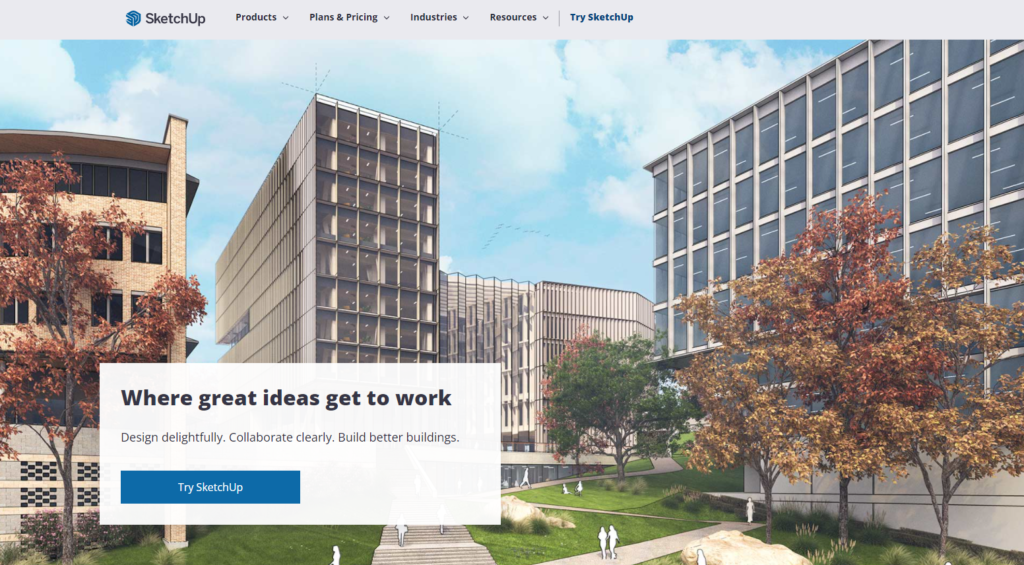
Popular in the industry SketchUp is a powerful tool for those designers who need exact precision and don’t require the use of templates. It’s best for interior designers who are willing to invest time in learning how to use it since the interface isn’t exactly intuitive.
Built for: Interior designers who are willing to invest time in learning a more complicated platform.
Features:
- 2D Drawing and 3D imaging
- 3D design and modeling
- Animation
- Annotations
- Architectural symbol library
- BIM modeling
- Collaboration tools
- Component and content library
- Data import/export
- Document generation
Pros and Cons:
Great for creating accurate 3D visuals and 2D documentation, especially in interior design. Offers a vast asset library and seamless plugin integration, including rendering tools. However, SketchUp has a learning curve, occasional lag with large files, and limited rendering features without extensions. Better suited for users ready to invest time in mastery.
Pricing: SketchUp starts from $119 per year for a basic plan, $349 per year for professional work, and $749 per year for advanced workflows.
Reviews: SketchUp has an average rating of 4.5 (out of 1,041) on Capterra and 4.5 (out of 1,316) on G2.
Platform: Windows and MacOS
11. Foyr Neo
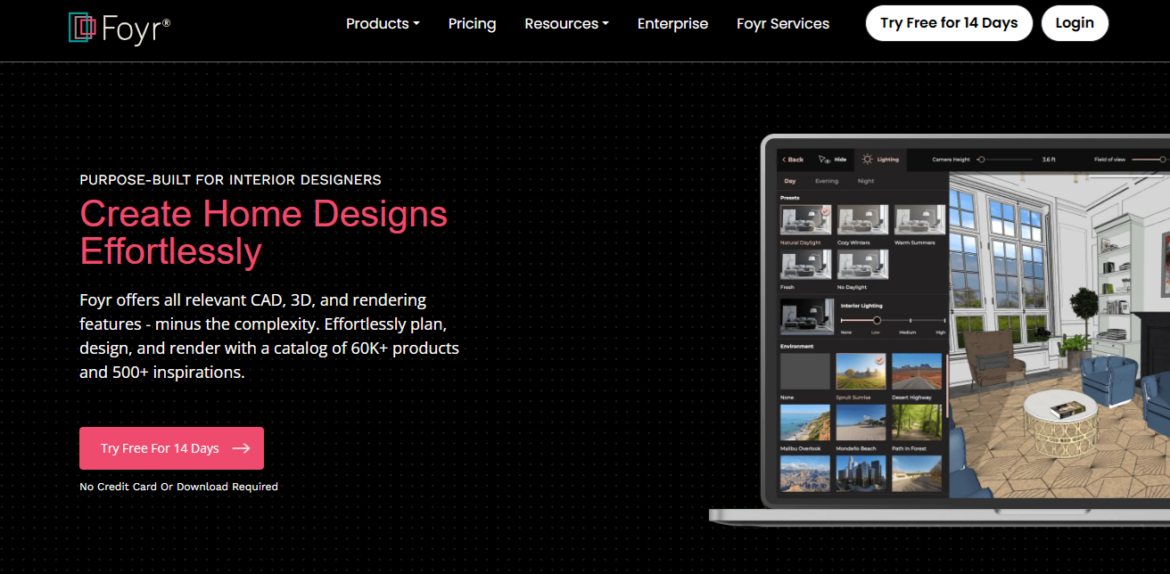
Foyr Neo is an all-in-one 3D visualization tool built specifically for interior designers. It combines floor planning, 3D modeling, and high-quality rendering in one easy-to-use platform. With a drag-and-drop interface, 60,000+ 3D models, and built-in tools for creating photorealistic 4K renders and 360° walkthroughs, it helps bring your designs to life quickly and professionally.
It also includes AI features like smart lighting simulations and augmented reality previews—but those are just part of a much broader toolset that’s focused on speed, ease of use, and client-ready visuals.
Built for: Interior designers who want a streamlined platform to design, model, and render all in one place, without a steep learning curve.
Features:
- 2D and 3D floor planning
- 60K+ 3D furniture, decor, and material assets
- Real-time 3D editing and layout adjustments
- Custom product and texture creation
- 4K photorealistic rendering
- 360° virtual walkthroughs
- Augmented reality previews (FoyrAR)
- Moodboard builder
- Built-in shopping list and budgeting tool
- PDF exports for easy sharing with clients
Pros and Cons:
Designed with interior designers in mind, this platform makes it easy to move from floor plans to polished, client-ready visuals without jumping between tools. The drag-and-drop workflow and fast 4K renders are big wins. That said, some users report occasional glitches and mixed experiences with billing and support, which may require extra attention for long-term use.
Pricing:
Foyr Neo offers flexible plans based on how often you render and how many users you need. Plans start at $39/month for the Basic tier, which includes HD–4K rendering, access to the full product catalog, and unlimited projects. The Standard plan is $89/month and adds 3D walkthroughs, floor plan exports, AR viewing, and more render credits for active designers. For growing firms, the Premium plan starts at $159/month and includes higher render limits, multiple users, custom 3D model requests, and dedicated support. All plans come with a 14-day free trial, and seasonal promotions may offer additional discounts or bonus render credits.
Reviews: Foyr Neo has an average of 4.0 stars (out of 23 reviews) on Capterra.
Platform: Web
12. Enscape by Chaos
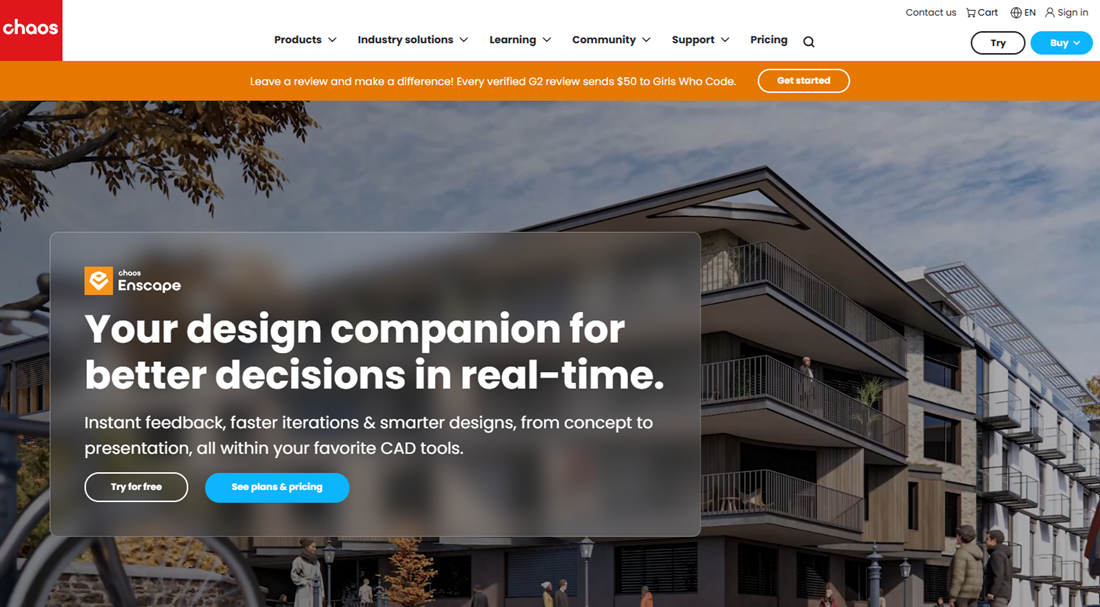
Enscape is a real-time rendering plugin loved by architects and designers for its speed, simplicity, and smooth integration with popular CAD tools like Revit, SketchUp, Rhino, and Archicad. With just one click, you can turn your models into fully rendered walkthroughs, making it ideal for live client presentations, internal reviews, and fast visual feedback during the design process.
Recent enhancements include AI-powered tools for scene enrichment and ideation, which add even more polish and variety to your renders, without requiring extra software or steep learning curves.
Built for:
Designers and architects who want high-quality, real-time visualization directly inside their 3D modeling workflow.
Features:
- One-click real-time rendering and animated walkthroughs
- Native plugin support for Revit, SketchUp, Rhino, Archicad, and Vectorworks
- AI-enhanced tools for ideation and automatic scene enrichment
- Built-in Chaos Cosmos library with 14,000+ assets and materials
- VR support for immersive client presentations
- Thermal comfort and energy performance insights (Enscape Impact)
- Clean, user-friendly interface that’s beginner-friendly
- Mac and Windows support
Pros and Cons:
The Enscape plugin makes rendering feel effortless, especially for those already working in tools like Revit or SketchUp. Its real-time feedback, VR support, and AI features speed up decision-making and client presentations. While the output quality isn’t always as refined as premium renderers, the ease of use and speed more than make up for it.
Pricing:
Plans start at $47.90/month (billed annually) for Solo users. The Premium plan is $52.90/month and includes AI tools, while the ArchDesign Collection is $94.90/month and adds cinematic animation, sustainability insights, and large-scene support. All plans include a 14-day free trial, free learning resources, and a 14-day money-back guarantee.
Reviews:
Enscape has an average of 4.4 stars (out of 71 reviews) on Capterra and 4.6 stars (out of 367 reviews) on G2.
Platform:
Windows and Mac (via plugin for Revit, SketchUp, Rhino, Archicad, and Vectorworks)
13. HomeVisualizer.ai
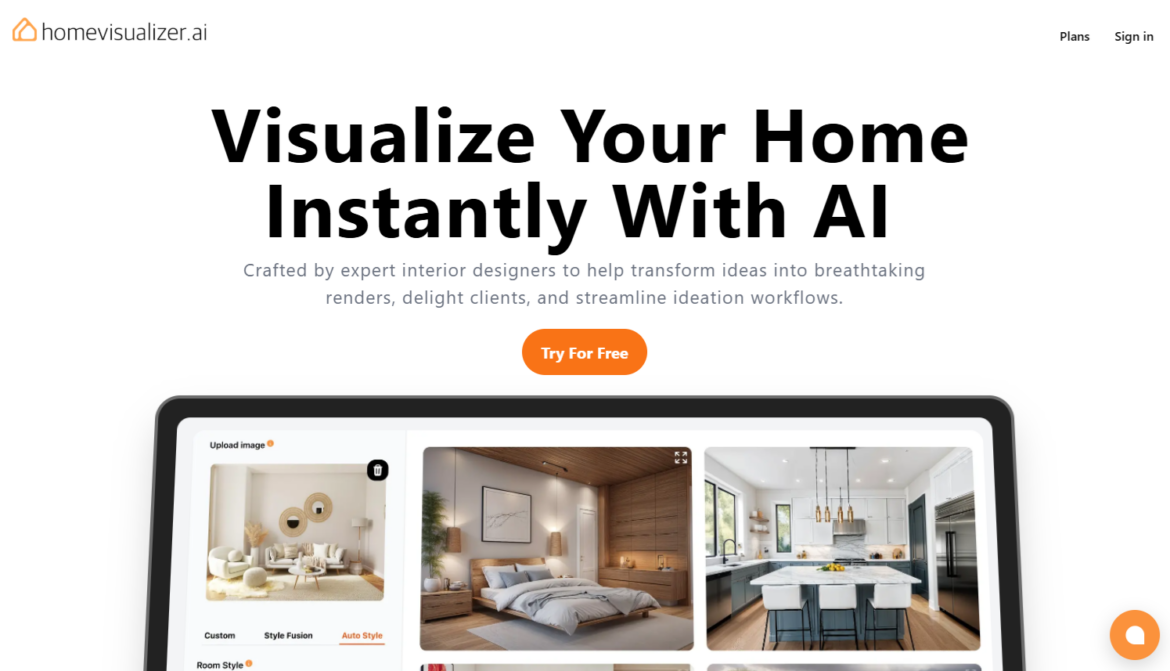
HomeVisualizer.ai is a fast, photo-based rendering platform designed for professionals who need high-quality interior visuals—without the time or tech required for traditional rendering. Whether you’re working from a photo, sketch, elevation, or basic render, it uses smart design modes to transform rough concepts into polished, client-ready images in just a few clicks.
It’s especially handy when you’re short on time or working through early-stage design ideas with a client. While it runs on AI, the focus here is on quick, clean rendering—no steep learning curves or extra tools needed.
Built for:
Interior designers, real estate agents, architects, and anyone who needs fast, high-quality 2D renderings from basic inputs.
Features:
- Upload photos, sketches, elevations, or renders to create photorealistic visuals
- Three design modes: Auto Style, Custom Requests, and Style Fusion
- Apply curated design themes or provide specific style instructions
- Supports room, kitchen, landscape, and exterior renderings
- Works with rough inputs while maintaining spatial accuracy
- No watermarks and commercial licenses available on select plans
- Cloud-based with privacy-first data policies (no AI training on user uploads)
- Designed to be beginner-friendly while offering advanced control for professionals
Pros and Cons:
Perfect for early-stage ideation or quick visual upgrades, this tool lets you turn basic photos, sketches, or renders into polished, client-ready images in seconds. It’s incredibly easy to use and doesn’t require advanced skills, but it’s limited to 2D outputs, so it may not suit complex design workflows.
Pricing:
Plans start at $12/month (250 renders) for the Standard plan. The Pro plan is $21/month (1,000 renders), and the Business plan is $75/month (5,000 renders), with discounts on annual billing. All plans include access to every design mode, watermark-free downloads, and varying usage rights based on tier.
Reviews:
HomeVisualizer.ai does not currently have public review scores.
Platform:
Web-based (accessible from any browser—no download required)
14. ArchiVinci
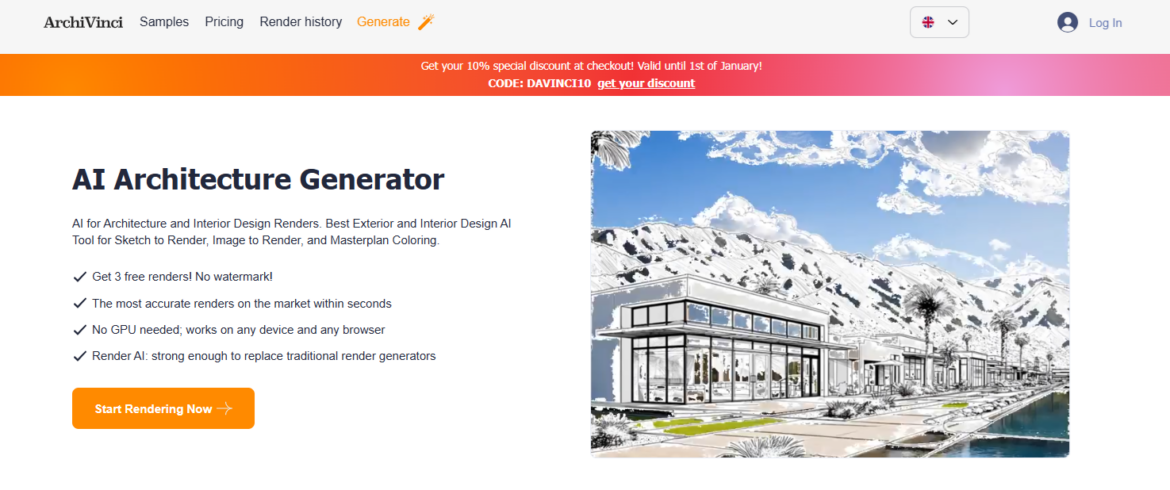
ArchiVinci is a browser-based rendering platform that turns sketches, photos, or screenshots into polished visuals within seconds—no downloads, no special hardware, and no rendering background required. It’s built specifically for architecture and interior design, making it a great fit for designers who want fast, professional-quality renders without all the extra setup of traditional software.
While ArchiVinci does use AI to speed things up, the focus here is on getting beautiful, accurate renders for interiors, exteriors, masterplans, and staging projects, all in a fraction of the time.
Built for:
Interior designers, architects, real estate pros, and anyone who needs fast, accurate visuals without installing heavy rendering software.
Features:
- Sketch-to-render and photo-to-render tools for quick visual transformation
- Interior, exterior, urban planning, and virtual staging modules
- Style transfer and image upscaling tools to polish and personalize your output
- 360° panorama generator and support for 4K–8K image exports
- Modify rooms or architecture without starting over using inpainting tools
- Video creation and design variation tools available through add-on credits
- Coin-based advanced tools like ArchiGPT for refining renders or creating animations
- Commercial usage rights included with all paid plans
Pros and Cons:
A great fit for designers who want fast, browser-based rendering without complex tools or downloads. It handles everything from interiors to masterplans with impressive accuracy and polish. However, some users have reported occasional glitches and credit loss during video exports, so keep an eye on usage if you’re relying on add-on features.
Pricing:
ArchiVinci offers flexible plans based on how long you need access. Choose from 3 days ($39), 1 month ($79), or a yearly plan ($699). All premium plans include unlimited rendering, access to all standard tools, and support for high-res exports. Extra features like video generation or ArchiGPT are available as optional add-ons with coin-based pricing.
Reviews:
ArhciVinci has 4.0 stars out of 5 reviews on Trustpilot.
Platform:
100% web-based (runs in your browser on any device—no downloads or GPU needed)
15. Interior AI
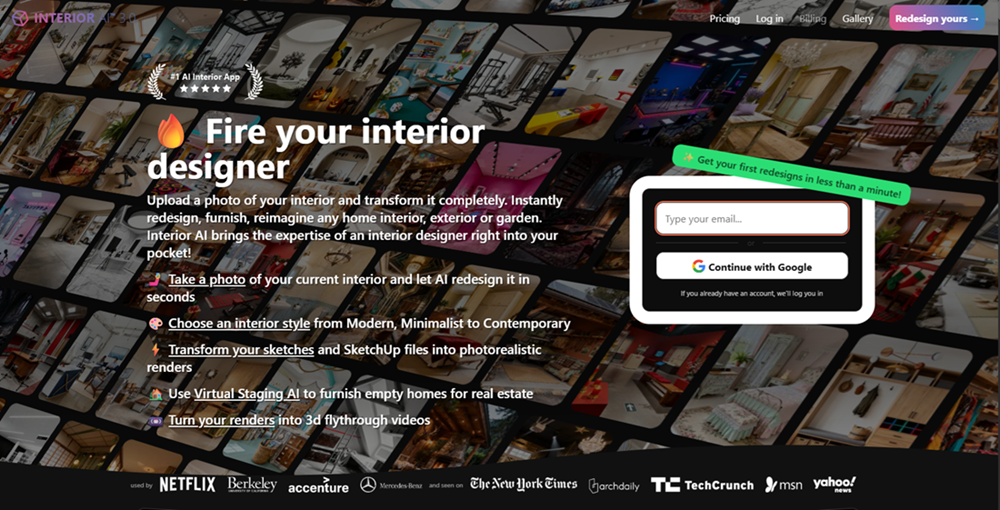
Interior AI is your fast-track to stunning space makeovers with minimal effort. Upload a photo, pick a style, and voilà, your room is completely reimagined in seconds. While the platform is powered by AI, its real charm lies in just how simple it makes rendering polished interiors, whether you’re staging for real estate or exploring new design directions for a client.
It even supports outdoor spaces, SketchUp renders, and 3D flythrough videos—perfect for creating jaw-dropping visuals without touching a single design software.
Built for:
Interior designers, real estate agents, homeowners, architects, and visual storytellers looking for quick, high-quality transformations without the fuss.
Features:
- Upload room photos and transform them instantly using 55+ curated interior design styles
- Convert sketches and SketchUp wireframes into realistic photorealistic renders
- Create immersive 3D flythrough videos from your rendered spaces
- Virtually stage empty rooms with furniture, lighting, and décor
- Customize colors, lighting, furniture, even add people to bring spaces to life
- Design outdoor areas with plants, landscaping, and patios
- Supports parallel rendering for high-volume workflows
- Explore before-and-after views and VR-style walkthroughs in a click
Pros and Cons:
Extremely easy to use and fast for generating styled interiors, even from rough photos or SketchUp models. Professionals love the range of styles and virtual staging tools. That said, some users note limited control over layout precision and occasional inaccuracies, especially with more complex rooms or architectural details. Great for speed, less for nuance.
Pricing:
Interior AI offers a free trial, with full plans starting at $29/month for 1,000 low-quality renders. The Premium plan ($49/month) adds hyper-realistic lighting, virtual staging, and advanced editing tools. Need even more? The Ultra plan ($99/month) supports up to 25,000 designs/month, ultra-quality renders, and priority rendering with dedicated servers. All plans are billed annually with 6+ months free.
Reviews:
Interior AI has 4.6 stars (out of 5 reviews) on G2.
Platform:
Browser-based (works on any device, no downloads required)
FAQs about rendering software
Here are the answers to the most common FAQs about rendering software.
Rendering software is a specialized computer program used to create lifelike visualizations of designs, helping clients envision projects before development.
These tools benefit interior design professionals and their clients alike.
While mood boards and sketches have their place in the design process, renderings reduce ambiguity and offer a clearer vision, allowing the designer, client, and any other collaborators to align from the get-go.
For interior designers, often a more simple rendering tool works best. D5 Render is one of the highest-rated rendering software platforms out there. It’s an affordable, speedy, and user-friendly program that provides high-quality renders. It would work well in conjunction with a program like DesignFiles, which offers project management functionality.
If your resources are limited, Blender is a good free option. For larger companies willing to invest in training, 3ds Max Design and Cinema 4D can create complex 3D models.
There are lots of rendering programs that offer free versions, though they may have limitations compared to paid software. Here are a few of the best free rendering options available:
Blender is a free platform with maximum features and no limitations. It’s a powerful and versatile open-source 3D creation suite, although it has a steep learning curve. Basic Planner 5D is a free plan with a few limitations. The free version is a great place to start and you can design your space with a number of objects from the catalogue. However, there are little customization possibilities compared to the Premium package. SketchUp is excellent for creating basic 3D models and applying simple textures and materials. While the free version has limitations on exporting and rendering quality, it’s a good starting point.
Ultimately, the ideal software hinges on your specific requirements. If you prioritize speed and user-friendliness, D5 Render, DesignFiles, or Planner 5D might be excellent choices. For projects demanding intricate detail, Blender (free yet has a steeper learning curve) or professional options like 3ds Max Design and Cinema 4D could be better choices. Or, you might want to choose a design software with the best all-around features (including rendering). If so, check out DesignFiles.

![Top 9 Interior Design Project Management Software [2026]](https://blog.designfiles.co/wp-content/uploads/2024/06/AdobeStock_215623020-768x512.jpeg)