
As interior designers grow their businesses, administrative work has a way of quietly taking over. There are always lead follow-ups, contracts, invoices, scheduling, and endless email threads to contend with.
After nearly two decades reporting on the tools, workflows, and business trends that shape successful design firms, I’ve learned that the right CRM supports growth, while the wrong one creates more work than it solves.
A CRM (customer relationship management) system should help interior designers manage leads, onboard clients smoothly, automate communication, and get paid, without forcing them to overhaul their entire workflow or juggle yet another complicated platform. The challenge isn’t finding a CRM. It’s choosing one that supports how design businesses really operate, today and as they grow.
In this guide, we break down the best CRMs for interior designers based on real-world use, not just feature lists.
We’ll compare the most popular options, share where each one shines (and where they fall short), and help you identify which CRM makes sense for your business stage, soso you can grow efficiently, stay organized, and spend more time designing instead of managing software.
Table of Contents
How shuld interior designers choose a CRM?
After years of watching how interior designers actually use CRMs in their businesses, I’ve learned that choosing the “best” option isn’t about having the most features. Sometimes, it’s about picking a system that supports growth without adding friction.
Here’s what matters most when evaluating CRMs for interior designers:
- CRMs are built for relationships, not products. Most CRMs do a solid job managing leads, contracts, and payments, but they aren’t designed to handle product-heavy workflows like selections, revisions, approvals, purchasing, or installs. This is where many designers hit a wall.
- Designers lose the most time in follow-ups and scattered communication. Missed emails, forgotten check-ins, and manual reminders are where projects quietly slow down. A good CRM reduces this chaos with automation, but only if it fits naturally into how you work.
- No single CRM replaces design-specific software. The most efficient designers don’t force one platform to do everything. They pair a CRM with design software so each tool handles what it does best. The CRM handles lead intake and follow-up while the design software manages design, products, and project execution.
- Complexity is the hidden cost. A CRM that looks powerful on paper can become a burden if it takes months to set up or constant tweaking to maintain. Growth-friendly systems are the ones designers actually stick with.
The right CRM should support your business as it grows, not require you to rebuild your workflow around it. In the rest of this guide, I’ll break down the most popular CRMs used by interior designers, explain who each one is really best for, and help you choose an option that keeps your business organized without adding unnecessary complexity.
What features to look for in a CRM for interior designers
The best CRMs for interior designers are made to make things easier for clients and business owners alike. On your end, these tools decrease the amount of time you spend on tasks like sending emails and tracking prospective clients by creating a consistent system for every administrative task, adding automation, and monitoring data for you automatically. For customers, the CRMs provide a smooth and professional feel throughout the project by keeping style, delivery methods, and response tasks consistent throughout every project phase (inquiries, quotes, contracts, invoices, email communication, etc).
Some of the most essential features to look for in a CRM include:
- Sales pipelines – for moving clients from discovery calls to onboarding to live projects.
- Automated workflows – For sending automated emails, such as meeting reminders and follow-up messages.
- Email marketing – For finding new leads in the same place you grow them.
- Appointment booking – With calendar integrations for easy scheduling.
- Proposal and invoice sending/payment processing – To send quotes and take payments without the need for additional accounts.
- File storage – For contracts, project information, and more.
- Team collaboration – For task assignments and approvals if you work with contractors or employees.
- Project management – For making sure every task is completed, from communication within the CRM to general project tasks (blueprints, product choices, client approval, etc).
If this all sounds overwhelming and difficult to master, remember you don’t need to use every CRM feature in the beginning. In fact, it’s often better to start with one or two and work your way up from there. It’s better to have a few tools mastered in a way that truly benefits your business than to be trying to run multiple systems that you don’t fully understand. Try not to feel daunted by the sheer number of available features, and simply pick a plan that meets your immediate needs and offers a viable path toward a fully integrated future.
Benefits of using a CRM
Running a design business means juggling creativity, communication, and admin all at once. A good CRM helps you stay on top of it all, without dropping the ball. Here’s how a CRM can seriously elevate your business behind the scenes:
Stay on top of every client touchpoint
CRMs give you one clear view of every client’s journey, from first inquiry to final invoice. You can track conversations, tasks, appointments, and approvals without chasing through email threads or sticky notes. This keeps your projects moving smoothly and your clients feeling supported every step of the way.
Work smarter with automation
You don’t need to do it all yourself. Many CRMs let you automate tasks like follow-up emails and meeting reminders, so you can focus on the creative work.
- Save time with automated workflows
- Set up meeting reminders, email sequences, and payment nudges
- Never forget a follow-up again
Boost your sales and revenue
CRMs organize your process and grow your profits, too. In fact, 97% of businesses using a CRM hit or exceeded their sales goals last year, and those using AI-driven CRMs were 83% more likely to exceed their targets.
Impress with a mobile-friendly experience
Whether you’re working from your laptop or running between installs, mobile CRMs help you stay in sync. And it’s not just convenient. Businesses using mobile CRM tools are 150% more likely to exceed their sales goals.
- Access client info and timelines on the go
- Reply to leads faster
- Keep your whole team in the loop
Make client experience your secret weapon
A CRM helps you deliver a more polished, personalized experience. From consistent communication to streamlined onboarding, everything feels smoother—and that builds trust. It’s no wonder 53% of businesses say CRM tools helped improve customer satisfaction and retention.
Comparing the top 10 CRMs for interior designers
Below, we’ve got two comparison tables for the best CRMs. First we compare them for key features. Then we take a side-by-side look at free plans, pricing, and ratings.
Feature comparison
| Invoicing & Payments | Workflow Automation | Appointment Scheduling | |
| Honeybook | ✅ | ✅ | ✅ |
| Dubsado | ✅ | ✅ | ✅ |
| HubSpot | ✅ | ✅ | ✅ |
| Pipedrive | ✅ | ✅ | ✅ |
| Bonsai | ✅ | ✅ | ✅ |
| Monday.com | ❌ | ✅ | ✅ |
| Zoho | ✅ | ✅ | ✅ |
| ClickUp | ❌ | ✅ | ❌ |
| Salesforce | ✅ | ✅ | ✅ |
| Nimble | ✅ | ✅ | ❌ |
Pricing and ratings comparison
| Free Plan | Paid Plan Monthly Pricing Range | Ratings | |
| Honeybook | ✅ | Monthly paid plans ranging from $19 to $79 | 4.5 on G2 and 4.7 on Capterra |
| Dubsado | ✅ | Monthly paid plans ranging from $20 to $40 | 4.2 on G2 and 4.3 on Capterra |
| HubSpot | ✅ | Monthly paid plans ranging from $20 to $3,600 | 4.4 on G2 and 4.5 on Capterra |
| Pipedrive | ❌ | Monthly paid plans ranging from $24 to $99 | 4.3 on G2 and 4.5 on Capterra |
| Bonsai | ❌ | Monthly paid plans ranging from $15 to $59 | 4.3 on G2 and 4.6 on Capterra |
| Monday.com | ✅ | Monthly paid plans ranging from $36 to $72 | 4.7 on G2 and 4.6 on Capterra |
| Zoho | ✅ | Monthly paid plans ranging from $20 to $65 | 4.1 on G2 and 4.3 on Capterra |
| ClickUp | ✅ | Monthly paid plans ranging from $10 to $19 | 4.7 on G2 and 4.6 on Capterra |
| Salesforce | ✅ | Monthly paid plans ranging from $25 to $100 | 4.5 on G2 and 4.4 on Capterra |
| Nimble | ❌ | Monthly paid plan at $29.90 | 4.5 on G2 and 4.4 on Capterra |
Comparison summary
Here’s a quick overview of all the tools we cover in this list:
- Honeybook is perfect for interior designers who want an easy, polished client experience with strong invoicing, payments, and automation.
- Dubsado stands out for deep customization and advanced workflows—great for tech-savvy designers ready to set up a system that runs itself.
- HubSpot is a powerful choice for studios focused on marketing, client pipelines, and automation, though it comes with a steeper learning curve (and price tag).
- Pipedrive is ideal for lead tracking and sales-focused workflows, especially if you want something simple and scalable without all the bells and whistles.
- Bonsai is a smart all-in-one tool for newer designers who want to combine CRM, contracts, time tracking, and finances in one place.
- Monday.com shines for team collaboration and project management, though it needs add-ons to handle payments and invoicing.
- Zoho is a solid, budget-friendly option for those wanting essential CRM tools with a generous free plan and strong integrations.
- ClickUp is great for designers already using it for project management—it’s flexible and highly customizable, though not built as a CRM first.
- Salesforce offers enterprise-level power with automation, analytics, and integrations, best suited for growing teams ready to invest in robust features.
- Nimble is all about relationship-building and is a good fit for solo designers or small teams looking for streamlined contact management and communication tools.
Top 10 CRMs for interior designers
Take a look at our list of the best CRM platforms for interior designers, from solo firms to teams.
#1: Honeybook
BEST FOR: Honeybook is best for solo interior designers and small studios who want a polished, client-facing CRM that handles inquiries, contracts, invoices, and scheduling with minimal setup. It’s especially well-suited for designers offering full-service or e-design work who value ease of use and a professional client experience over deep customization or advanced automation.
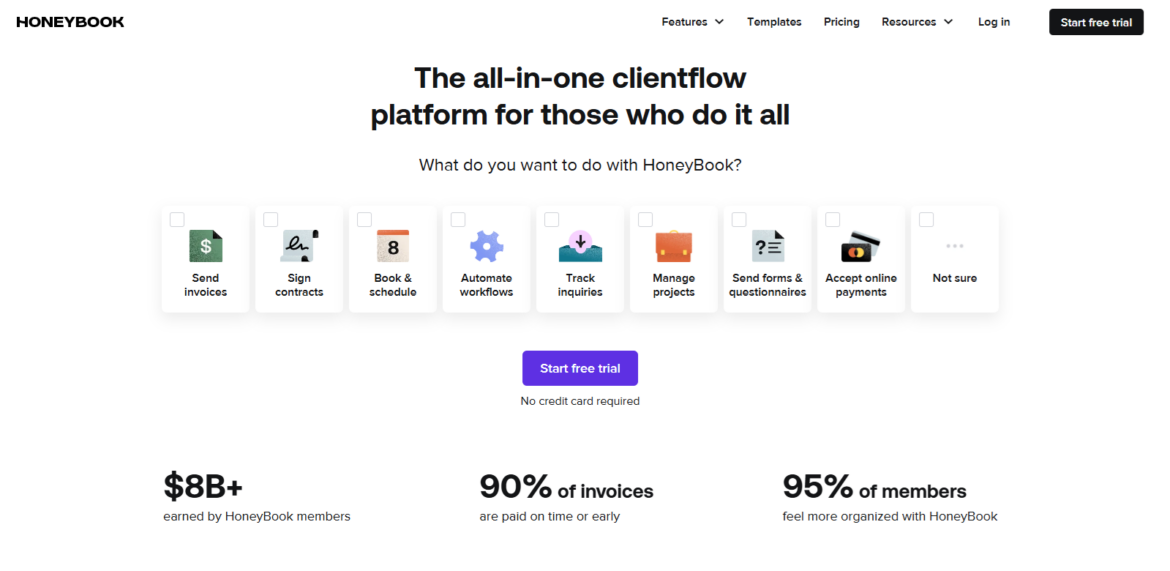
Honeybook is one of the most commonly used CRMs for interior designers. It offers a simple yet professional feel for both clients and business owners.
Top Features:
- Send invoices and accept online payments
- Create and sign contracts
- Book and schedule appointments
- Automate workflows, from emails to onboarding tasks
- Track inquiries
- Manage projects
- Send forms and questionnaires
Pros: Honeybook is easy to use. For customer support, you can chat with live agents instead of chatbots. Free account set-up and extensive training resources will help you get the most out of your subscription. The mobile app provides on-the-go account access. And you can easily link other essential accounts, such as Calendly, Zoom, Quickbooks, and Ads.
Cons: Honeybook can only be used in the United States or Canada. It does not offer a free account level, and processing fees on payments are slightly higher than those of other sites. Honeybook doesn’t link with social media sites for post scheduling. We also wish there were more branding/customization opportunities within Honeybook’s CRM pipelines.
My experience: In my experience using Honeybook, it stands out for how quickly you can get up and running without feeling overwhelmed. The two features that consistently impressed me were the all-in-one client flow (inquiry → contract → invoice → payment) and the client-facing experience, which feels clean and professional with very little effort. Honeybook works best for designers who want structure without having to build everything from scratch. That said, I wouldn’t recommend it for designers who need heavy customization, advanced automation, or complex workflows — especially those managing large teams or highly detailed projects. It’s a strong fit for growing design businesses that want simplicity and consistency, but not for power users who like to deeply customize every step.
Pricing: All account levels have a 7-day free trial and a 60-day money-back guarantee. Honeybook offers several sales throughout the year, so it’s worth watching prices for a while if you’re looking for a CRM on a budget.
| Account Level | Monthly Plan Cost | Yearly Plan Cost |
| Free for up to one project | $0 | $0 |
| Starter | $19 | $192 |
| Essentials | $39 | $384 |
| Premium | $79 | $792 |
Reviews:
Honeybook has 4.5 stars on G2 and 4.7 stars on Capterra.
What users have to say: Users frequently praise Honeybook for being easy to use and for bringing everything into one centralized platform. One reviewer shared, “I like how easy it is to use and how so many aspects of an essential business are included such as the invoicing, questionnaires, proposals, etc.” Another noted that it “makes my business more professional when dealing with clients,” especially for small business owners. On the critical side, some users mention pricing and limitations as their business grows. One reviewer cautioned, “The price is too steep for what they’re offering now,” while another warned that migrating away from Honeybook can be difficult, saying, “If you try to leave, they provide no easy way to export your data.” Overall, users love Honeybook for simplicity and professionalism, but note that it may feel limiting or expensive for more advanced needs.
#2: Dubsado
BEST FOR: Dubsado is best for interior designers who want deep customization and automation and are willing to invest time upfront setting up their systems. It’s especially well-suited for growing studios or designers planning to scale, rather than those looking for a simple, plug-and-play CRM.
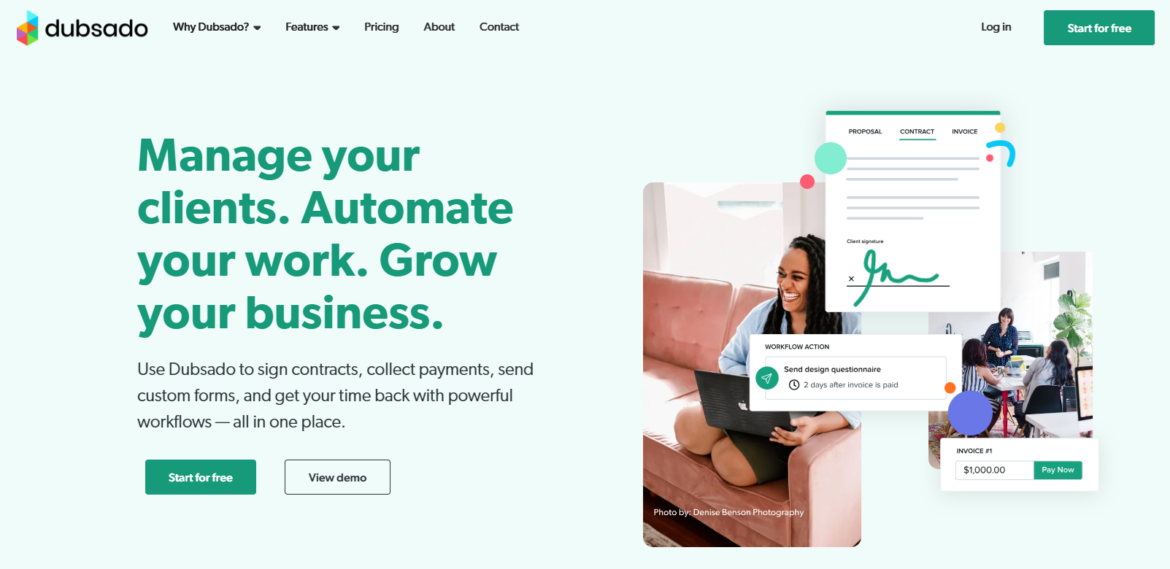
Dubsado is another common choice for interior designers. This CRM offers highly customizable workflows and automation, allowing you to create exactly what your business needs.
Top Features:
- Payments and invoicing
- Automated workflows (email and project-based)
- Appointment scheduling
- Forms, proposals, and contracts
- Project management
- Time tracking for billable hours
Pros: Dubsado can be used anywhere in the world. It integrates with email, video, and calendar apps, as well as Quickbooks, Xero, Zapier, and Cloudspot. Dubsado customer service responds quickly during business hours and offers demos, 1:1 screen share sessions, and courses to help you learn the system. It also offers a higher level of customization than most CRMs for interior designers.
Cons: The features and customization options are so extensive that they can overwhelm new users. Several essential features, including both scheduling and automation, are only available with the premium plan.
My experience: In my experience using Dubsado, it’s one of the most powerful CRMs available to interior designers—but that power comes with a learning curve. The standout features for me were the advanced workflows and the ability to fully customize proposals, contracts, and automations to match very specific business processes. Once everything is set up, Dubsado can run large parts of your business on autopilot, from inquiry follow-ups to invoices and questionnaires. I’d recommend Dubsado to designers who enjoy building systems, have complex workflows, or plan to scale with a team. I wouldn’t recommend it to designers who want something intuitive out of the box or who feel overwhelmed by too many configuration options—those users may find it more frustrating than helpful.
Pricing: Dubsado is free for your first 3 clients. This gives you as much time as you need to build your systems. On top of the costs below, you will need to pay $10 per month per additional brand (if you own more than one company) and a set fee per user if your team has more than 3 employees ($25 per month for 4-10 users, $45 per month for 11-20 users, or $60 per month for 21-30 users).
| Account Level | Monthly Plan Cost | Yearly Plan Cost |
| Starter Plan | $20 | $200 |
| Premium Plan | $40 | $400 |
Reviews:
4.3 stars out of 50 reviews on Capterra; 4.2 stars out of 71 reviews on G2.
What users have to say: Many users praise Dubsado for its automation and scalability. One reviewer shared, “Once automations are set, they work seamlessly whether I’m managing just one person or a whole team… which has been revolutionary for me.” Another highlighted efficiency, saying, “The first time I sent a proposal, it was accepted, contract signed, and invoice paid within five minutes.” On the flip side, some users point out usability challenges. One reviewer noted, “It’s not always a simple plug-and-play experience, and sometimes you have to search and figure things out,” while another mentioned concerns around billing and setup complexity. Overall, users love Dubsado’s power and flexibility, but consistently mention the learning curve as the tradeoff.
#3: Hubspot
BEST FOR: HubSpot is best for interior design firms that want marketing, sales, and CRM tools under one roof, especially those with a strong focus on lead generation and growth. It’s a better fit for larger studios or designers with dedicated marketing efforts than for solo designers who want a simple, lightweight CRM.
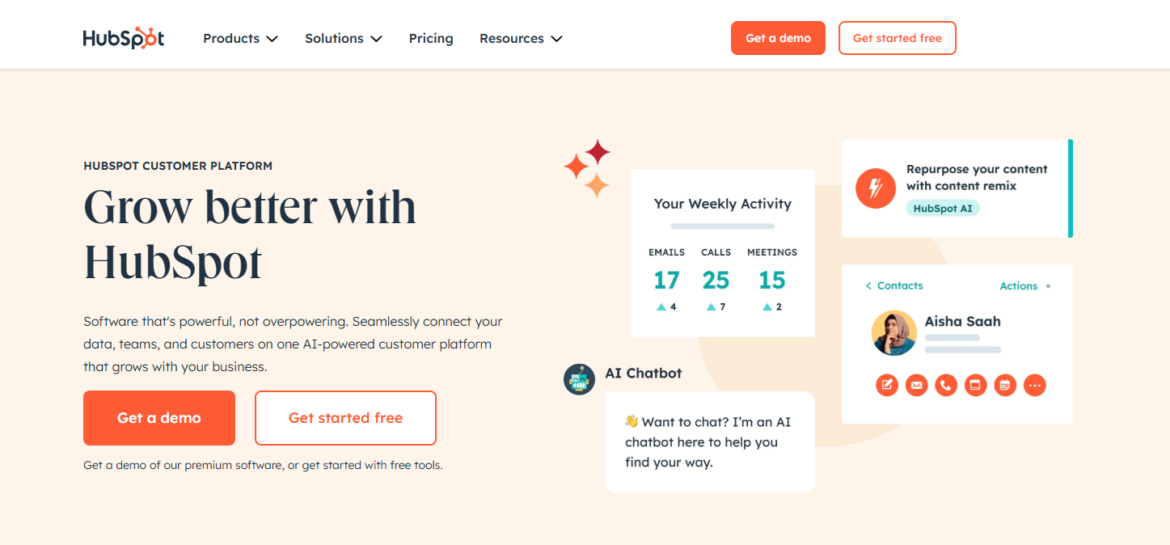
Hubspot is an extensive CRM with several upgrade options. It’s great for designers who want to take care of all of their marketing tasks in one place.
Top Features:
- Marketing: Email marketing, ad management, forms
- Sales: Contact management, deal pipeline, meeting scheduling
- Customer Service: Team email, AI chatbot, ticketing
- Content: Website builder, landing pages, SEO recommendations
- Commerce: Payment links, quotes, invoices
- AI: AI blogs, webpage generator, email generator
Pros: Hubspot offers more features than most CRMs for interior designers. It works exceptionally well for large companies. It also scales well, so you don’t have to worry about switching CRMs as you grow.
Cons: Once you begin upgrading plans, Hubspot gets expensive quickly. Annual contracts lock users in for a full 12 months. The extensive features can feel overwhelming to some users at first.
My experience: In my experience using HubSpot, it’s one of the most comprehensive platforms available, but it can feel like more than most interior designers actually need. The standout features for me were the email tracking and automation—being able to see when leads open emails or click links is incredibly helpful—and the tight integration between marketing and sales, which gives you a clear picture from first inquiry to signed client. Overall, HubSpot feels polished, powerful, and built for scale. I’d recommend it to growing studios or multi-person teams that actively invest in marketing and want detailed reporting and automation. I wouldn’t recommend it to solo designers or smaller firms who primarily need contracts, invoices, and scheduling, as the cost and complexity can outweigh the benefits.
Pricing:
| Account Level | Monthly Plan Cost | Yearly Plan Cost |
| Free, limited features | $0 | $0 |
| Marketing Hub Starter | $20 per month per seat | $180 per seat |
| Starter Customer Platform | $20 per month per seat | $180 per seat |
| Marketing Hub Professional (up to three seats) | $890 per month | $9600 |
| Marketing Hub Enterprise | $3600 per month | $43,200 |
Reviews:
HubSpot has 4.4 stars on G2 and 4.5 stars on Capterra.
What users have to say: Users consistently highlight HubSpot’s centralized system and automation. One reviewer shared, “HubSpot brings my entire sales process together… the email tracking and templates give me the insight I need to reach out at the right moment.” Another praised its organization, saying, “It puts all the leads, deals, emails, tasks, and meetings in one place, which makes staying organized much easier.” On the downside, pricing and complexity come up often. As one user noted, “Advanced features are locked behind higher-tier plans, and the costs can ramp up quickly,” while another mentioned that “the initial setup took over a month and had a noticeable learning curve.” Overall, users love HubSpot’s power and visibility, but acknowledge that it’s an investment in both time and budget.
#4: Pipedrive
BEST FOR: Pipedrive is best for interior designers who want a clean, visual way to track leads and sales activity without getting buried in complexity. It’s a strong fit for designers who are sales-focused and want a CRM that’s easy to adopt and grow into over time.
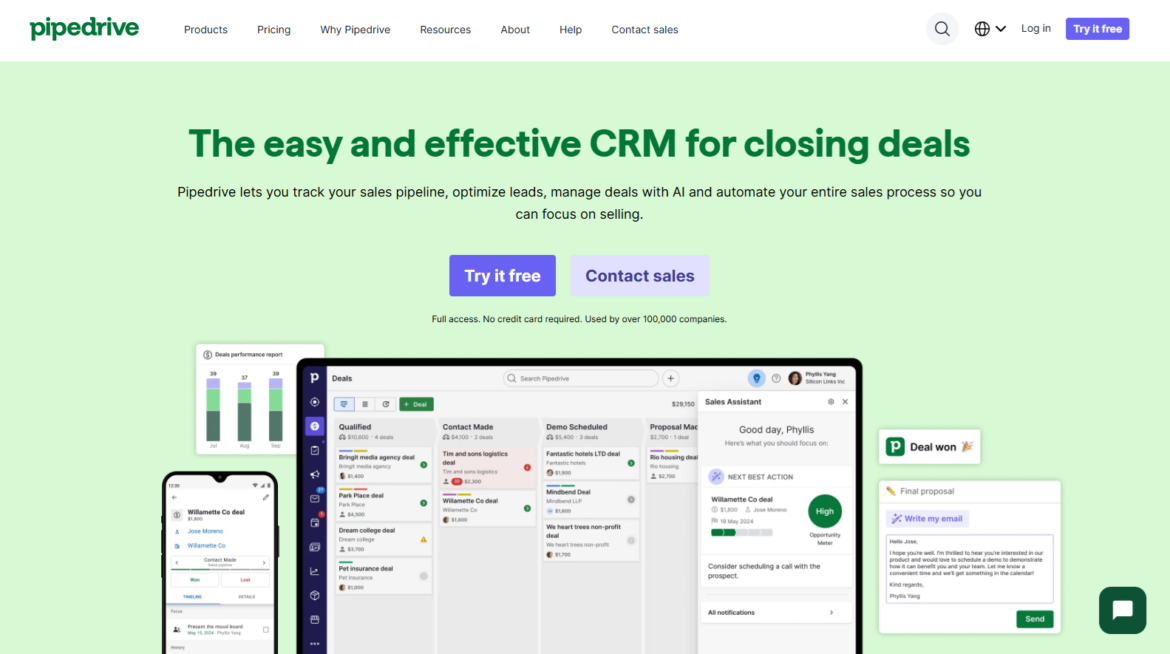
Pipedrive is another great CRM for interior designers who want to track leads and take away some of the mundane tasks that come with marketing, onboarding, and invoicing.
Top Features:
- Client interaction and communication
- Email marketing
- Integrations
- Pipelines and automation
- Lead data tracking
- Invoicing and payments
Pros: Pipedrive offers affordable plans and features similar to those of other great CRMs. Pipelines and forms can be highly customized. It offers a simple feel with the ability to learn and scale over time.
Cons: Pipedrive does not offer a free account. Their customer service phone calls are only available to Power users.
My experience: In my experience using Pipedrive, it’s one of the most intuitive CRMs I’ve worked with. The standout features for me were the visual, drag-and-drop pipelines and the activity reminders, which make it easy to see exactly where every lead stands and what needs attention next. Overall, Pipedrive feels streamlined and efficient rather than overwhelming. I’d recommend it to designers who want a straightforward system for managing inquiries, follow-ups, and deals without heavy setup. I wouldn’t recommend it to designers looking for deep automation, advanced reporting, or an all-in-one solution for complex workflows—those users may find it a bit limited.
Pricing: Costs kick in after a 14-day free trial.
| Account Level | Monthly Plan Cost | Yearly Plan Cost |
| Lite | $24 | $168 |
| Growth | $49 | $468 |
| Premium | $79 | $708 |
| Ultimate | $99 | $948 |
Reviews:
Pipedrive has 4.3 stars on G2 and 4.5 stars on Capterra.
What users have to say: Users consistently praise Pipedrive for its ease of use and visual layout. One reviewer shared, “The drag and drop pipeline makes it easy to see where every deal stands at a glance,” while another said, “It’s very easy to complete tasks and stay organized, this has become part of my daily workflow.” On the critical side, some users mention limitations with integrations and reporting. One reviewer noted, “The reporting is useful for basic insights, but it feels limited for more advanced analysis,” and another pointed out that “some integrations, like accounting tools, could be stronger.” Overall, users love Pipedrive’s simplicity and organization, with tradeoffs around deeper analytics and integrations.
#5: Bonsai
BEST FOR: Bonsai is best for solo interior designers and very small studios who want client management, contracts, invoicing, and basic project tracking in a single, affordable platform. It’s a strong option for designers early in their business who want simplicity and time-based billing without juggling multiple tools.
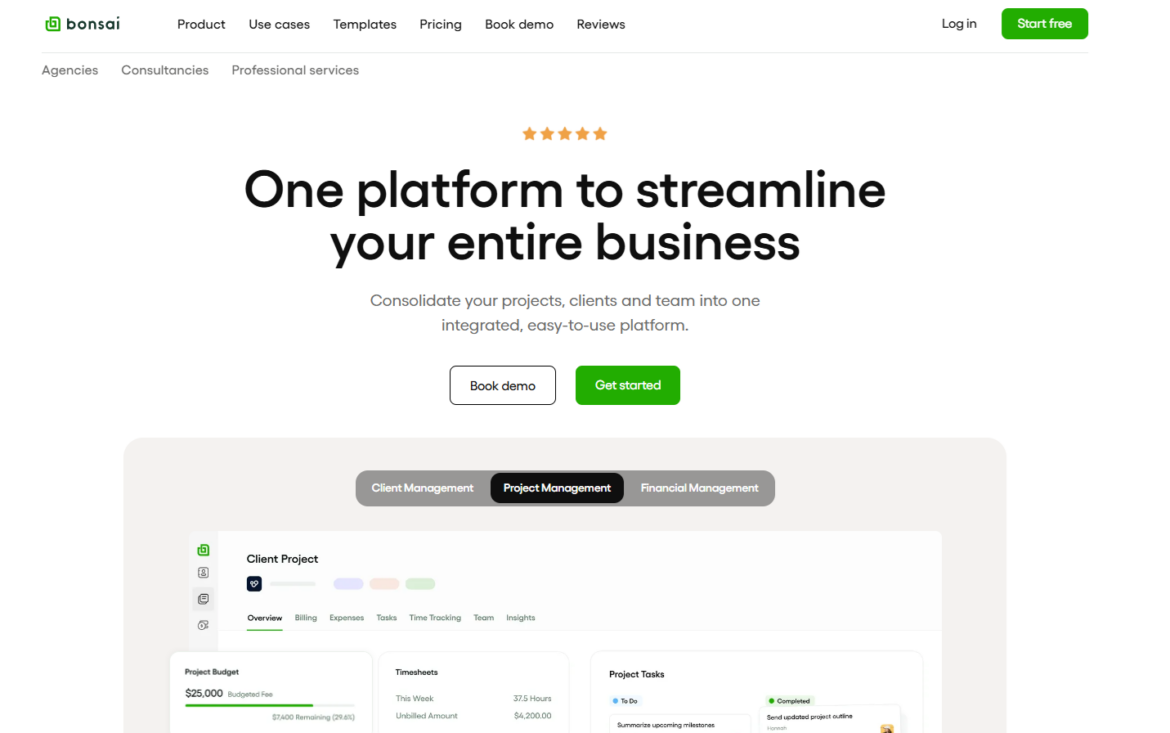
Bonsai is a CRM that combines client management, project management, and financial management. It’s great for beginners or designers who want to keep all three of these tasks in one place.
Top Features:
- Client management
- Workflow automation
- Proposals and contracts
- Appointment scheduling
- Billable time tracking
- Task management
- Invoicing and payments
- Business reports
Pros: Bonsai works well for smaller businesses. The time tracker is a unique feature that allows you to bill directly for hours tracked. Calendly, QuickBooks, and Zapier integration add to what this CRM can do for your business.
Cons: Payment processing fees are higher than average. Customer support could be improved to include phone calls and immediate agent access via chat. Other CRMs have more features than Bonsai at similar price points.
My experience: In my experience using Bonsai, it feels like a practical, no-frills system designed to keep day-to-day admin moving without overcomplicating things. The standout features for me were the built-in time tracking that automatically rolls hours into invoices and the ability to manage proposals, contracts, and payments from one place. Overall, Bonsai feels approachable and efficient, especially for smaller operations. I’d recommend it to designers who bill hourly, run lean businesses, or want a single system for basic client and financial management. I wouldn’t recommend it to growing studios with complex workflows, heavy automation needs, or a desire for deep customization—those users may quickly outgrow Bonsai’s feature set.
Pricing: Charges begin after a 7-day, full-access free trial. Also available are team seats for $10 each per month and a tax tracker (track expenses, write-offs, and estimate quarterly taxes) for $10 per month.
| Account Level | Monthly Plan Cost | Yearly Plan Cost |
| Basic | $15 | $108 |
| Essentials | $25 | $228 |
| Premium | $39 | $348 |
| Elite | $59 | $588 |
Reviews:
Bonsai has 4.3 stars on G2 and 4.6 stars on Capterra.
What users have to say: Bonsai’s simplicity and all-in-one approach is popular with users. One reviewer shared, “The ability to track my time and have the hours automatically populate into an invoice has been incredibly time-saving,” while another said, “It’s minimal, affordable, and super user-friendly—I was able to set my business up in no time.” On the downside, customer support comes up frequently. One user noted, “Customer support can be difficult to work with and slow to respond,” while another described Bonsai as “a jack of all trades, master of none.” Overall, users love Bonsai for its ease of use and efficiency, but note limitations around support, customization, and advanced features.
#6: Monday.com
BEST FOR: Monday.com is best for interior design teams that need strong project and task management alongside basic CRM functionality. It’s especially well-suited for studios managing multiple projects, collaborators, or departments that want visibility across work in progress.
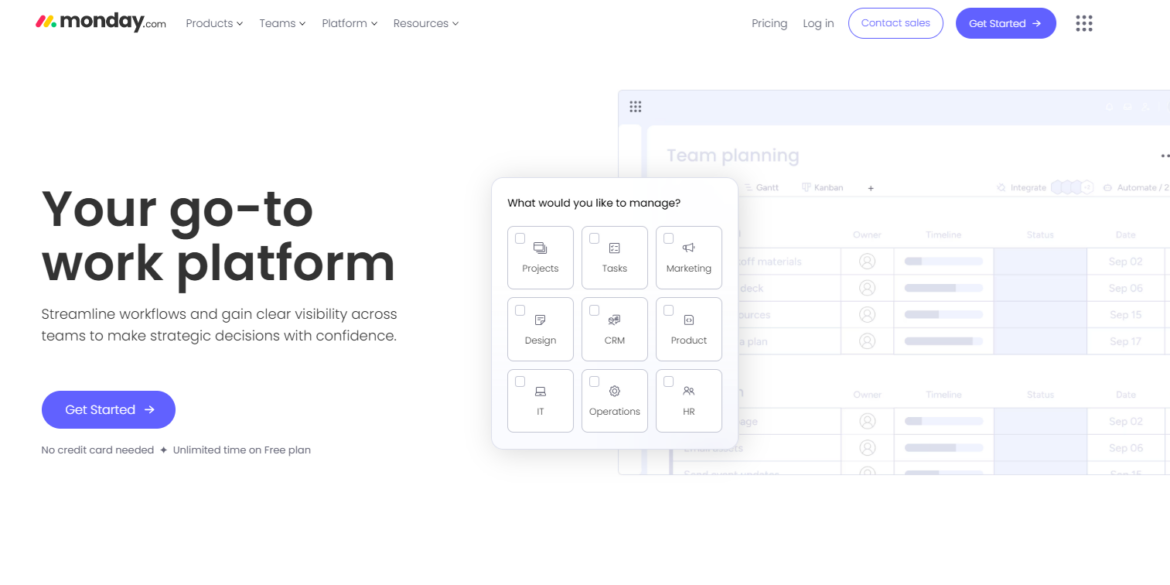
Monday’s CRM offers excellent project management, especially among teams. It has grown to also offer a CRM platform that can be used with or without the traditional task management system.
Top Features:
- Project and task management
- Contact and lead management
- Sales pipelines
- Email marketing
- Client onboarding
Pros: A free plan is available for your first two seats. Everything is customizable, and templates can speed things up. Customer support is easily accessible via live chat or phone call.
Cons: Monday lacks on the financial side. To send invoices and accept payments, you will need to integrate third-party applications. There is also a learning curve in most areas.
My experience: In my experience using Monday.com, it shines most as a visual project management system first, CRM second. The standout features for me were the highly customizable boards and the real-time visibility across tasks, owners, and timelines, which make it easy to keep teams aligned and projects moving. Overall, Monday feels flexible and powerful once it’s set up, but it does require intentional planning to avoid overcomplicating workflows. I’d recommend it to design studios with teams who need structure, accountability, and collaboration across projects. I wouldn’t recommend it to solo designers or firms looking for built-in invoicing, payments, or a simple client lifecycle CRM—those users will likely find Monday too heavy or incomplete without additional tools.
Pricing: Pricing varies greatly by team size. Below are the costs for three seats. You can view the rest of Monday’s pricing here. An Enterprise account level is also available, you can chat with Monday’s sales team to learn more.
| Account Level | Monthly Plan Cost | Yearly Plan Cost |
| Free, up to 2 seats and 3 boards | $0 | $0 |
| Basic | $36 | $324 |
| Standard | $42 | $432 |
| Pro | $72 | $684 |
Reviews:
Monday has 4.7 stars on G2 and 4.6 stars on Capterra.
What users have to say: Monday.com’s flexibility and visibility is frequently cited in user reviews. One reviewer shared, “It’s visual and customizable—I can see job statuses and deadlines at a glance without digging through spreadsheets,” while another noted, “The platform keeps everyone aligned and has helped us reduce missed details and constant back-and-forth.” On the downside, pricing tiers and setup complexity come up often. One user mentioned, “Some useful features are locked behind higher-tier plans,” while another pointed out that “because it’s so flexible, it takes time to design the right structure, and boards can get cluttered if you’re not careful.” Overall, users love Monday for team collaboration and organization, with tradeoffs around learning curve and reliance on integrations.
#7: Zoho
BEST FOR: Zoho is best for interior designers who want a low-risk entry into CRMs, especially those trying a system for the first time. It’s also a solid option for designers who rely heavily on integrations and want flexibility without committing to a higher-priced platform right away.
Zoho is great for a first CRM tool because it offers a forever-free account level. It also integrates well with other sites you may already use, such as MailChimp, Ads, and Google Analytics.
Top Features:
- Contact and lead management
- Appointment scheduling
- Workflow automation
- Sales process builder
- Reports and analytics
- Quotes, invoices, and payments
- Team collaboration
Pros: Zoho’s mobile app allows for easy on-the-go business management. A free plan is available for small businesses. It’s easy to use and integrates with more than 500 applications.
Cons: Zoho offers less customization than other CRMs. The free plan does not include access to integrations.
My experience: In my experience using Zoho, it feels like a capable, budget-friendly CRM that offers more depth than you’d expect at its price point—especially with the free plan. The standout features for me were the strong lead and contact management and the wide range of integrations, which make it easy to connect Zoho to tools designers may already use. Overall, Zoho feels functional and dependable, though not as polished or intuitive as some higher-end CRMs. I’d recommend it to solo designers or small firms testing out CRM systems or working with tight budgets. I wouldn’t recommend it to designers who want advanced customization, highly visual pipelines, or a seamless out-of-the-box experience, as Zoho can feel complex during setup and limited on the free plan.
Pricing: More information about the free plan can be found here.
| Account Level | Monthly Plan Cost | Yearly Plan Cost |
| Standard | $20 per user | $168 per user |
| Professional | $35 per user | $276 per user |
| Enterprise | $50 per user | $480 per user |
| Ultimate | $65 per user | $624 per user |
Reviews:
Zoho has 4.1 stars on G2 and 4.3 stars on Capterra.
What users have to say: Users often highlight Zoho’s flexibility and affordability. One reviewer shared, “Zoho CRM is incredibly flexible and affordable, with extensive customization and seamless integrations,” while another said, “Everything is centralized now, and I probably save about 90 minutes every day.” On the downside, setup and usability are common concerns. As one user noted, “The initial setup was confusing and took almost a week to figure out,” and another mentioned that “the interface can feel cluttered and overwhelming at times.” Overall, users appreciate Zoho’s value and feature depth, but acknowledge the learning curve that comes with it.
#8: ClickUp
BEST FOR: ClickUp is best for interior designers or studios that already rely on ClickUp for project management and want to layer CRM functionality into an existing system. It’s also a strong fit for teams that value flexibility and want to manage projects, tasks, and client data in one place.
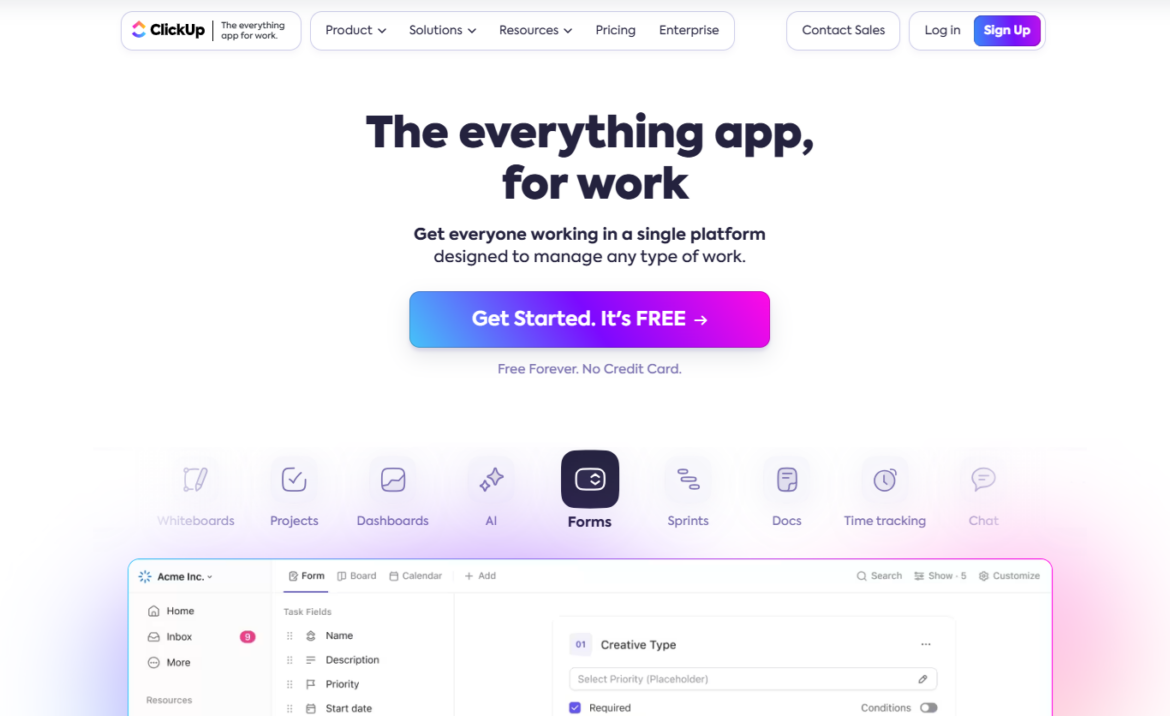
ClickUp is a popular project management software that also offers a CRM tool. If you already use ClickUp in your business, you may find it easy to add this CRM instead of something from a completely new site.
Top Features:
- Client management
- Sales pipelines and automation
- Data tracking and analyzation
- Client onboarding and communication
- Invoicing and payment processing templates
Pros: ClickUp’s CRM is highly customizable. It works well for teams, as everyone can assign tasks. You can even assign updates to a client portal for quick approval.
Cons: ClickUp has a learning curve, so it will take some time to master the tool if you do not already use it.
My experience: In my experience using ClickUp as a CRM, it feels incredibly powerful—but only if you’re willing to be intentional about setup. The standout features for me were the deep customization and the ability to combine project management and CRM workflows in one system, which can eliminate the need for multiple tools. Once configured, ClickUp can track leads, manage onboarding, and keep projects moving with clear ownership and visibility. I’d recommend ClickUp to designers who already use it or who enjoy building custom systems for their business. I wouldn’t recommend it to designers looking for a simple, ready-made CRM experience, as the learning curve and sheer number of options can feel overwhelming at first.
Pricing: ClickUp begins with a free-forever account (which can have as many free team members as you’d like). Each level up includes more features to streamline your business.
| Account Level | Monthly Plan Cost | Yearly Plan Cost |
| Free, basic features | $0 | $0 |
| Unlimited | $10 per user | $84 per user |
| Business | $19 per user | $144 per user |
| Enterprise | Custom Price | Custom Price |
Reviews:
ClickUp has 4.7 stars on G2 and 4.6 stars on Capterra.
What users have to say: ClickUp’s flexibility and all-in-one nature is mentioned often in reviews. One reviewer shared, “ClickUp’s sheer flexibility is its greatest strength, it consolidates tasks, docs, goals, and even lightweight CRM pipelines into a single platform,” while another noted, “I love the many ways I can organize our team, automations, and workflows. It keeps everything in one place.” On the critical side, onboarding comes up often. As one user put it, “It can be overwhelming for new users, and you really need to have your structure figured out first,” while another mentioned occasional performance slowdowns with large, highly customized workspaces. Overall, users love ClickUp’s power and customization, but consistently mention the learning curve as the main tradeoff.
#9: Salesforce
BEST FOR: Salesforce is best for established interior design firms or growing studios that want a highly customizable, enterprise-level CRM capable of handling complex sales, marketing, and service workflows. It’s a strong fit for teams that value data, reporting, and long-term scalability.
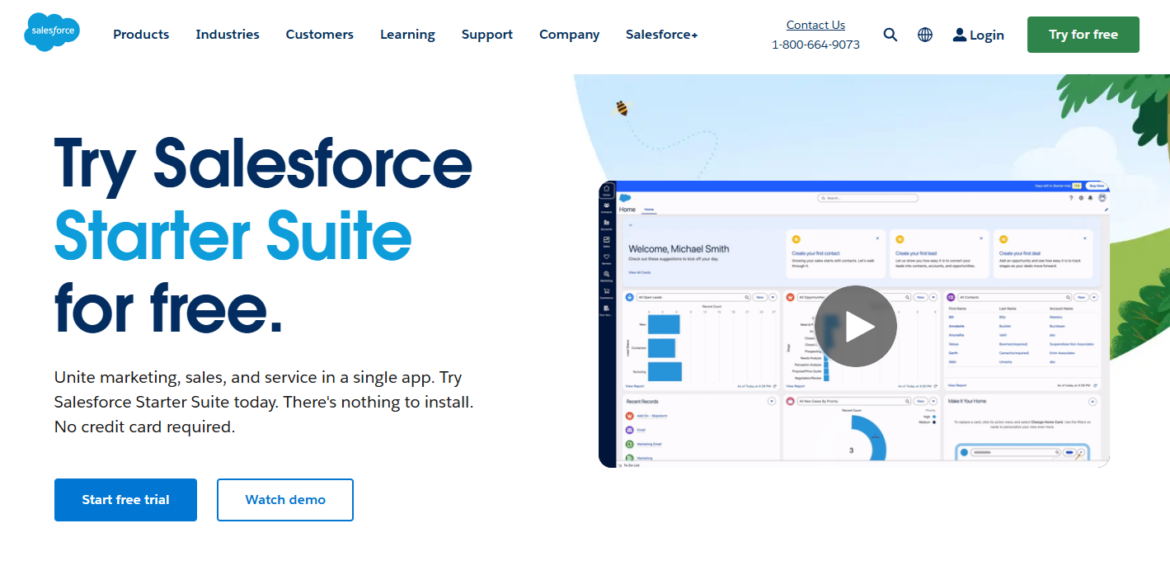
Salesforce calls itself the CRM for combining “marketing, sales, and service in a single app.” It has recently moved toward AI integration to further streamline most business tasks.
Top Features:
- Marketing automation
- Sales pipelines
- Sales engagement
- Invoicing and payments
- Data tracking and analytics
- Slack integration for team and client communication
Pros: Salesforce is specifically designed to reduce time spent on business tasks, even more so than other CRMs. It offers full customization and integrates with a variety of tools that you may already use.
Cons: Salesforce has extensive features and complex AI integration, so it may be difficult for some to master. It’s also only available on a yearly plan.
My experience: In my experience using Salesforce, it’s one of the most powerful CRMs available—but also one of the most demanding. The standout strengths for me were the depth of customization and the robust reporting and automation, which make it possible to model nearly any sales or client workflow. Overall, Salesforce feels built for scale and precision rather than speed or simplicity. I’d recommend it to larger design firms with dedicated ops support or admin resources who want a long-term system they can grow into. I wouldn’t recommend it to solo designers or small studios looking for a quick, intuitive setup, as the learning curve, complexity, and ongoing maintenance can outweigh the benefits.
Pricing: Salesforce offers various products for businesses of all sizes. Below are the costs for Small Business accounts. All plans come with a free 30-day trial.
| Account Level | Monthly Plan Cost | Yearly Plan Cost |
| Free, basic features | $0 | $0 |
| Starter Suite | $25 | $300 |
| Pro Suite | $100 | $1200 |
Reviews:
Salesforce has 4.5 reviews on G2 and 4.4 stars on Capterra.
What users have to say: Users consistently point to Salesforce’s power and flexibility. One reviewer shared, “Salesforce offers an extremely robust set of CRM tools with strong customization and reporting,” while another noted, “The dashboards give real-time visibility into performance and pipeline health.” On the flip side, complexity comes up often. As one user put it, “Salesforce has a steep learning curve and often requires admin or technical support,” while another mentioned that “simple changes can take longer than expected because of the platform’s complexity.” Overall, users view Salesforce as a best-in-class CRM for scale, with usability and setup as the primary tradeoffs.
#10: Nimble
BEST FOR: Nimble is best for relationship-driven businesses that prioritize staying in touch, following up consistently, and managing conversations across email and social platforms. It’s especially well suited for solopreneurs, consultants, and small design studios that grow through referrals rather than high-volume sales pipelines.
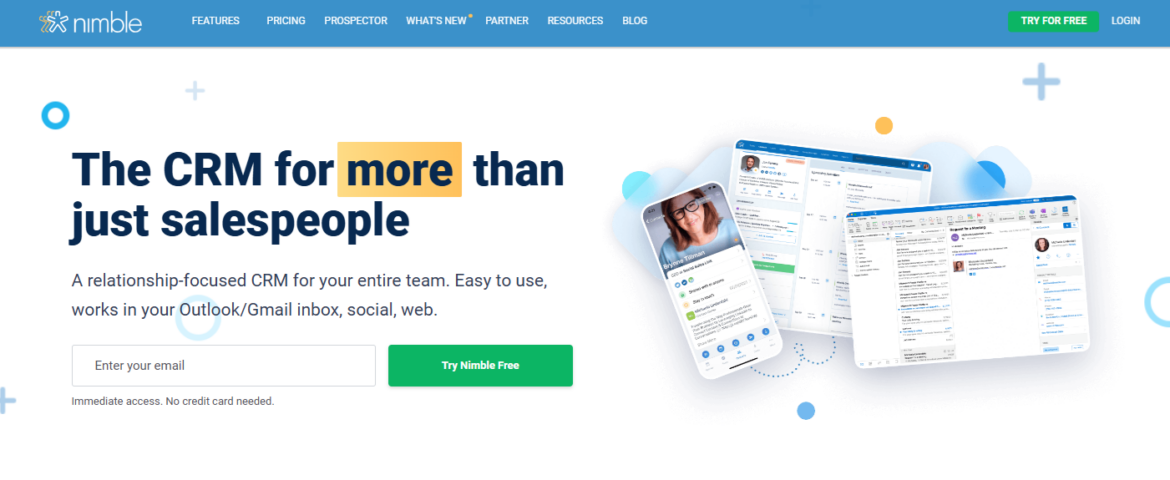
Nimble is a full-service CRM that is focused on relationships. It’s designed to be used by solopreneurs and teams alike, with opportunities to scale as your business grows.
Top Features:
- Workflows and automation
- Call scheduling
- File storage
- Team collaboration
- Email marketing
- Invoicing and payment processing
Pros: Nimble makes customer interaction easy with Google and Microsoft Suite integration, contact uploading, and social media tracking. It also offers impressive customer support, from online chat and email support to weekly webinars and free 1:1 training calls.
Cons: Nimble does not offer a free version. It also has fewer email marketing features when compared to other CRMs.
My experience: Using Nimble, my overall impression was that it’s refreshingly human and relationship-first compared to more sales-heavy CRMs. The standout features for me were the deep Google and Microsoft inbox integration and the contact enrichment and social insights, which make it incredibly easy to stay on top of conversations without constantly switching tools. Nimble feels intuitive, lightweight, and genuinely supportive of daily relationship management rather than rigid pipelines. I think it’s a great fit for solopreneurs, consultants, and small interior design studios that rely heavily on referrals, networking, and ongoing client relationships. It’s probably not the best choice for teams that need advanced email marketing, complex reporting, or highly customized sales automation at scale.
Pricing: Nimble only offers one plan level, which is exactly as shown below.
| Monthly Plan Cost | Yearly Plan Cost |
| $29.90 per seat | $298.80 per seat |
Reviews:
Nimble has 4.5 stars on G2 and 4.4 stars on Capterra.
What users have to say: Users frequently highlight Nimble’s ease of use and relationship focus. One reviewer shared, “Nimble takes out about 70% of the work required to find, understand, capture, and contact people,” while another said, “It’s extremely intuitive. Nothing is hidden, and the support is out of this world.” At the same time, limitations do come up. One user noted, “The 2GB storage limit fills up fast and pushes you into paid add-ons,” and another mentioned, “Reporting and advanced workflows can feel limited as your team grows.” Overall, users consistently describe Nimble as a simple, effective CRM that shines in relationship management, with tradeoffs around scale and advanced features.
Frequently asked questions about CRMs for interior designers
Dubsado is best CRM for individuals and small teams. It offers professional tools, from pipelines to project management. It’s also completely free for your first three clients, giving you time to build your systems before making your first payment. Unlike other services, the free account isn’t lacking any features. Prices rise gradually as you gain clients as well, keeping Dubsado affordable as you grow.
HubSpot is superior for large design firms, thanks to its integration of almost all online business tasks. Manage your client base, email marketing, website, social media, and team tasks all in one place.
The price is higher than other CRMs, but the time you’ll save (and the money you’ll save by forgoing other marketing subscriptions like email tools and social media schedulers) is sure to pay for itself over time.
HoneyBook, Dubsado, and HubSpot are the most common because they’re built for service-based businesses and creative workflows. Many designers start with HoneyBook because it’s easy to set up and handles proposals, contracts, and invoices in one place. As firms grow or add more complex processes, some designers switch to tools like Pipedrive, Monday.com, or even Salesforce for more advanced tracking.
CRMs allow interior designers to build communication systems. When a client schedules a meeting, for example, you can automate reminder and follow-up messages. You can place their contact information in a pipeline that walks them through proposals, onboarding, and payments.
These systems ensure that every necessary message is sent and followed through with, and also give things a more professional feel on the client end by keeping all communication forms consistent (created in the same, branded style and delivered in the same way).
Interior designers don’t need a CRM on day one, but most reach a point where spreadsheets, inboxes, and sticky notes stop working. A CRM becomes especially valuable once you’re juggling multiple inquiries, managing follow-ups, onboarding clients, and collecting payments at the same time. Designers who use a CRM consistently tend to respond faster, close more projects, and spend less time on admin.
No — and it shouldn’t try to. A CRM is designed to manage relationships, communication, and business workflows, while interior design software focuses on design execution, like mood boards, product sourcing, specifications, and presentations. Most successful interior designers use a CRM alongside tools like DesignFiles, Ivy, or Studio Designer rather than trying to force one system to do everything.
A CRM focuses on the client journey—from first inquiry to final invoice—while project management software focuses on tasks, timelines, and deliverables. For interior designers, CRMs are best at handling inquiries, contracts, payments, and communication, while project management tools are better for tracking installs, deadlines, and team responsibilities. Many designers use both, or choose a CRM that includes light project management features without becoming overly complex.
Yes. Many interior designers use HoneyBook or Dubsado alongside DesignFiles to separate business operations from design work. HoneyBook or Dubsado typically handle proposals, contracts, invoices, and client communication, while DesignFiles manages mood boards, sourcing, and design presentations. While these tools don’t fully replace one another, they complement each other well when each is used for what it does best.
The best CRM is one that supports your current workflow and allows room to grow, without forcing you into enterprise-level systems too early. If you’re a solo designer or small studio, simplicity and ease of use matter more than advanced reporting. Look for a CRM that reduces repetitive tasks, centralizes communication, and integrates with tools you already use, rather than one that requires heavy customization to feel usable.
CRMs for interior designers are filled with potential, but they aren’t created with design projects in mind. They are solely focused on customer relations. This means you’ll likely need additional interior design software for things like floor plans, 3D renderings, mood boards, and product libraries.
DesignFiles is the top-rated design software and it pairs nicely with one of the CRMs above. Most of our customers choose Honeybook or Dubsado to collect and track leads. Then, they use DesignFiles to manage every aspect of their projects. Start your free trial of DesignFiles today.