
You felt good about that proposal. The number looked right. Your client said yes without flinching, and the project started on schedule.
Then install week arrived. Then it arrived again the following week. By the time the last cushion was placed, you had worked most of a month you never billed for.
That is a pricing model problem. Not a client problem, and not a you-are-too-slow problem.
Interior design pricing models are the structures you use to turn your work into a fee. Flat fee, hourly, cost plus, percentage of project cost, and a few others you may not have tried. You probably picked one early, applied it to every project since, and never went back to the decision.
Here is what I would like you to consider instead. The model should follow the phase, not the project.
In six years of running pricing workshops for designers, almost nobody arrives asking which models exist. They arrive asking whether the one they already use is quietly costing them money.
And nobody is setting these prices for you. Small businesses drive 75 percent of industry sales, with small business sales projected at $30.9 billion for 2025.
This guide covers all eight models. It also includes a free calculator that runs one of your own projects through every one of them. Then how to choose between hourly and flat fee, the signs it is time to raise your rates, and how to test a change without spooking your pipeline.
Table of Contents
How interior designers actually get paid
Ask ten designers how they charge and you will get ten different answers. A few will sound slightly embarrassed about it.
There are a number of ways interior designers structure their fees. It depends on experience, expertise, location, and the scope of the project. Each interior design pricing strategy has its pros and cons. We enlisted Nancy Quinn of Profit Insiders Coaching to help us look closely at the most common ones. Her job here is to help you choose the pricing model that works best for you.
Quick housekeeping first. You will run into three phrases for the same idea: pricing models, fee structures, and pricing strategies. They mean the same thing. Contracts tend to say fee structures. Coaches tend to say pricing models. Nothing clever is hiding in the difference, so stop worrying that you missed something.
You can find the same structures listed on ASID’s costs and fees reference. Handy to point at when a client asks where your fee structure came from.
One boundary before the list. This page is about which structure to use. If what you need is the actual number, read how to price your interior design work. That one covers consultation fees, hourly rate maths, and stage-by-stage pricing.
And you do not have to pick one. Combining two or three is completely normal. That combination is usually what decides whether a project is profitable.
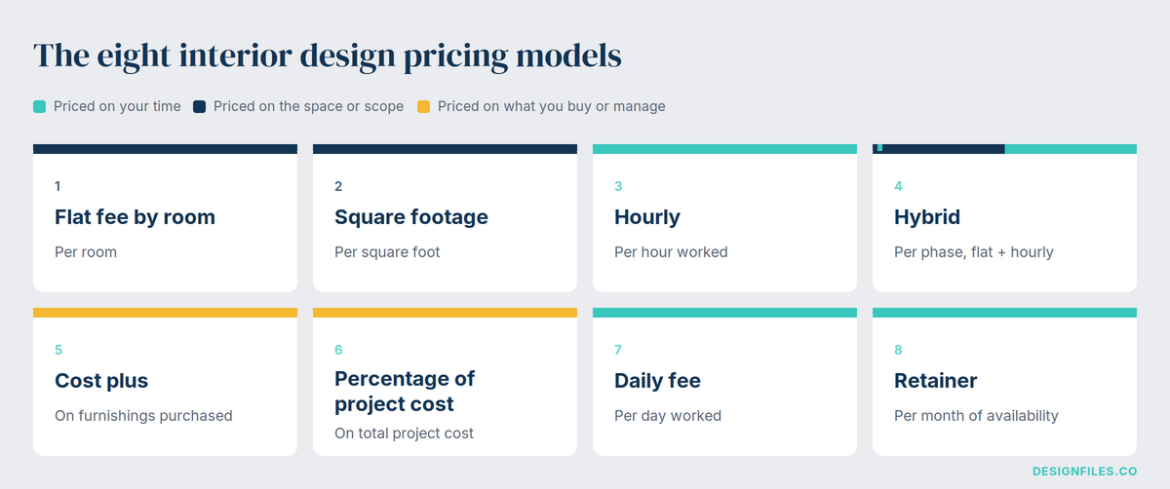
The eight interior design pricing models, compared
Before you read all eight, get clear on what you are choosing between.
Three questions decide which model fits a piece of work:
- How well can you forecast the hours?
- How much procurement are you handling?
- How much price certainty does this client need in order to say yes?
Answer those honestly and most of the eight eliminate themselves. A design phase you have run fifty times scores high on forecasting, so it wants a flat fee. An installation involving three contractors scores low, so it wants an hourly rate. A client who needs the total in writing before she signs will struggle with anything open ended.
I have watched designers switch from square footage to a flat fee by room and immediately earn more on the same work. The rooms did not change. The way the fee was explained did.
Use the table to narrow the field, then read the sections that apply to you. Skip the rest with a clear conscience.
| Model | Best for | Watch out for | Client reaction |
|---|---|---|---|
| Flat fee by room | Defined design scope | Scope creep with no change order | Strong, they know the number |
| Square footage | Large or repetitive spaces | Undercharging small complex rooms | Neutral, feels arbitrary to some |
| Hourly | Implementation, unpredictable work | Requires reliable time tracking | Anxious without estimates |
| Hybrid | Full service residential | Two structures to explain | Strong once explained |
| Cost plus | Procurement heavy projects | Trade price transparency questions | Mixed, depends on framing |
| Percentage of project cost | Large renovations and new builds | Fee rises with construction cost | Skeptical, invites negotiation |
| Daily fee | Short, intensive engagements | Defining what a “day” includes | Strong, easy to say yes to |
| Retainer | Ongoing or long timeline work | Defining what the retainer covers | Neutral to positive |
Want to see this on your own numbers? Our free pricing workbook runs one finished project through all eight models and shows what each would have paid you.
1. Flat fee by room
Description: This interior design pricing strategy requires a little more up front work to accurately calculate the overall scope of the project. For your flat-fee rate, you’ll want to factor in a set number of hours for discussing the project with the client, the time it takes you to complete the design deliverables, and what your limitation will be for requested design revisions.
If you’ve been actively tracking your hours on all your projects you should already have a pretty good idea about how long this process typically takes.
Pros:
The beauty of a flat rate structure is that clients love it. They know what their investment is going to be right out the gate for your design fees. And as you get better (and faster) over time, you can make more money per hour, even without raising your prices. If you want to see this structured into tiers, look at flat rate package examples.
Cons:
The downside of this method is that it doesn’t work well for project management and implementation. It’s nearly impossible to quote a flat rate fee accurately when you’re working with contractors and in charge of the installation. There are just too many variables that are out of your control.
2. By square footage
Description: With this interior design pricing strategy, designers charge an amount per square footage, meaning a larger living room project would result in a higher fee than a living room of a smaller size.
Pros:
If you feel that a larger room really does require more work, then this allows you to get paid for that. However, rather than charging by square footage for every project, it might make sense to have flat rates for rooms and different room sizes. For example, you might have a higher flat rate for large living rooms, and you can set the square footage parameters. You can decide whether to communicate these parameters to clients or not when quoting.
Cons:
The downside of this interior design pricing strategy is that you might undercharge for a smaller living room that actually takes the same amount of time. “I don’t love the square footage model,” says Nancy, “because if you are doing a living room, and you’re doing floor to ceiling and everything in between, why should you get paid less for all the same decisions, because the room is a little smaller?”
3. Hourly
Description: An hour worked is an hour paid. Depending on the type of work you do, this method might be a great fit but it does require you to be diligent about tracking those hours. That means tracking everything from phone calls, client meetings, designing, drafting, sourcing, ordering, purchasing and procurement, handling unforeseen complications, driving, installations, handling returns… you get the idea. By the hour is particularly ideal for hands-on, unpredictable work like working with contractors and handling installations.
Pros:
It’s the most accurate way to get paid for your work without having to worry about underquoting a project.
Cons:
Your clients might feel like they don’t know what’s coming. The uncertainty around the project total can cause stress and awkwardness, so be sure to do your best to quote hourly totals as accurately as possible, and update your clients with any hiccups.
Want to blend pricing models together into your own perfect combination? Nancy recommends her own hybrid pricing model, which we discuss in detail below.
4. Hybrid
Description: With Nancy’s hybrid pricing model, designers charge a flat fee for the design phase and then move to hourly pricing when it comes to project management (working with contractors, ordering products, installation, …etc).
“As you get more experienced, you can design faster, and you can still keep your flat rate price high,” explains Nancy. However, when it comes to managing installation and working with general contractors, so many factors are out of your control. That’s why an hourly fee makes sense. Here’s the big caveat: once you move to an hourly pricing model, ensure you’re estimating the number of hours and billing in advance. Don’t fall into the trap of billing in arrears.
With this pricing model, not only are you able to charge for your time fairly, but the client can also decide to manage the project themselves if, after the design is approved, they need to save money by going it alone. To learn more about Nancy’s hybrid pricing model, check out this video.
Pros:
You gain the best of both worlds (flat fee and hourly).
Cons:
You must estimate your hours and bill in advance, in order to avoid client confusion and/or disputes down the line.
Sarah Adnan moved through two models before this one stuck.
“After I realized that giving a fixed price to clients wasn’t making me any money at the end of the day, I went back and did some homework. Collectively, I figured out how many hours it would take to complete a project and used that to create my fixed rate, but for me personally, that still didn’t work. Now, the hybrid model is working well for me. It helps you set boundaries for your clients, you can say I’m happy to accompany you to this appointment, but it’s going to cost you.”
5. Cost plus on furnishings
You buy furnishings at trade pricing. You sell them to your client at your cost plus an agreed percentage. That percentage is yours.
Cost plus is a separate revenue stream from your design fee, and it is worth being precise about why. Your design fee pays for judgment. Cost plus pays for sourcing, vendor relationships, order management, and the years you spent learning which suppliers do not let you down. As Nancy puts it further down this page, those are two separate profitability streams you are entitled to.
The friction is predictable. At some point a client finds the trade price and asks about the difference. Have one clean sentence ready, and deliver it without apologising. Something like: my pricing covers sourcing and management, and I work to keep your total at or below retail.
This model rewards volume and relationships. If you handle full procurement, cost plus can quietly outperform your design fee. If you run a design only practice and your client buys everything herself, it does very little for you.
There is more to this than the mechanics. For the client conversations and the percentages, read how to explain markup to clients.
Seeing your margin before you send anything helps. DesignFiles shows cost, markup, and profit on every line item while you build the quote.
6. Percentage of project cost
Your fee is a percentage of the total project cost. Construction, furnishings, everything.
The appeal is that your compensation scales with scope. A gut renovation genuinely demands more of you than a single room refresh. This model reflects that without you having to itemise why. It suits large renovations and new builds, where the design work grows alongside the budget.
Now the part other guides skip. Your fee rises when the contractor’s costs rise. Your client will notice, and it hands her an obvious lever. Nobody enjoys explaining why a budget overrun worked out nicely for them.
Two protections make this workable. Agree the total project cost in writing before you start. Cap your fee at a stated ceiling. Both belong in the contract rather than in an email.
One distinction gets confused constantly, so hold onto it. Percentage of project cost applies to the whole project. Cost plus applies only to what you procure. You can run both at once, as long as you say so clearly.
7. Daily fee
You charge a set rate for each day you work on a project. Simple to quote, simple to say yes to.
Daily fees suit short, intensive engagements. A designer for a day service, a focused sourcing sprint, a single room you can finish inside a working day. They suit long projects with sporadic input much less well.
Define what a day buys before anyone books one. How many hours, what access, which channels, and what happens when the day runs over. Vague days become unpaid days.
You can deliver a daily fee in person, online, or entirely by message, which is where it gets interesting.
“The more I use the flat fee model, the more I enjoy the simplicity and low administrative burden. I offer Design Chat, which is different than most Designer for a Day as we communicate exclusively through text. Clients can chat with me for a whole business day or up to four weeks depending on their project.”
Chaney Widmer of Mix and Match Design
For more from Chaney, watch the workshop More Than a Number: How to Test Not Guess Your Pricing.
8. Retainer
A retainer is a fixed recurring payment that buys your ongoing availability.
It fits long timeline projects, phased renovations, and repeat commercial clients who need you reachable across months rather than weeks. You will rarely use it alone. Most often it sits on top of another model, as a deposit that secures your calendar and covers early concept work.
The whole thing hinges on definition. Say what the retainer buys, in hours or in deliverables. Say what happens to unused time at the end of each month. An undefined retainer becomes unlimited access, and unlimited access is how you end up answering texts on a Sunday for free.
Put that definition in the agreement itself. How to write a design contract covers the language. DesignFiles handles contracts and e-signatures, so the terms and the signature live in one place.
Nancy walks designers through packaging these models into services clients actually buy.
Hourly vs flat fee: which one fits the work in front of you
This gets framed as an identity question. Are you an hourly designer or a flat fee designer?
It is a scoping question. Which parts of this specific job can you actually forecast?
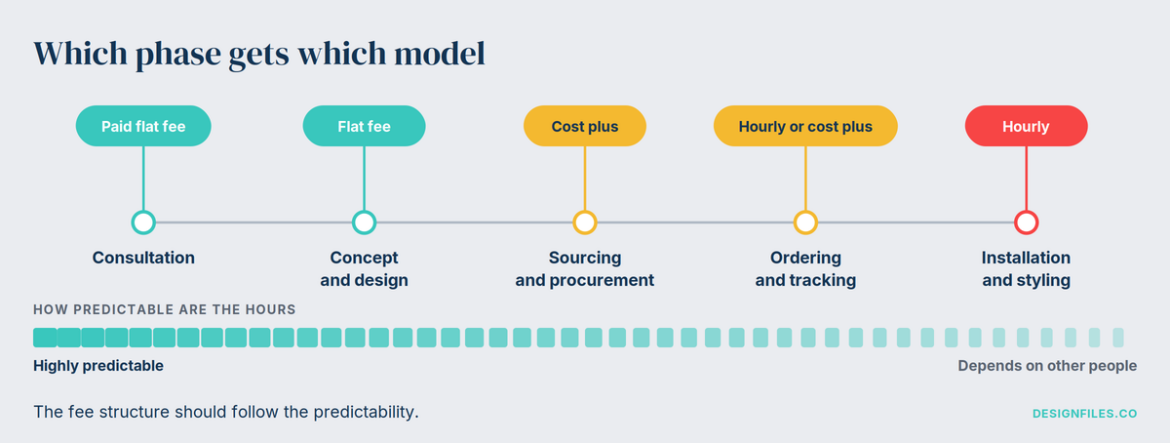
Design work is predictable. You have run the concept phase enough times to know roughly what it costs you. Implementation is not, because it depends on contractors, delivery dates, and a client who changes her mind about the sconces. Pricing an unpredictable phase as though it were fixed is where the money disappears.
A solo designer in one of my workshops was quoting whole projects at a single flat fee, installation included. On paper she was profitable. In practice she was working three unpaid weeks at the end of every job. We split her proposal into a flat design fee and an hourly rate for install oversight, billed in advance. Her revenue per project barely moved. The unpaid weeks disappeared.
When hourly earns its keep
Reach for hourly when the hours depend on someone who is not you.
Contractor coordination. Installation. Client led changes. Anything where a delayed delivery or a rescheduled trade adds a week you did not plan for. In those phases, hourly is the only structure that pays you for reality.
Two things make it work, and skipping either one is why designers give up on hourly.
Estimate the hours before you start, and say the number out loud. Nancy’s script further down this page is a good model for how to do that without alarming anyone. Then bill in advance, in blocks, rather than invoicing for work already done.
The third requirement is operational. Hourly only works if your tracking is reliable, and the designers who abandon hourly usually abandoned the tracking first. Track time inside the project itself rather than reconstructing your week on a Friday.
When a flat fee protects you better
Reach for flat fee when you have done this before and you know what it costs you.
Defined deliverables. A design phase with a clear finish line. Single room work. Any project where your client needs the total in writing before she can commit, which is more often than designers assume.
A flat fee is only as strong as the scope document behind it. The same fee that is generous at eighty hours becomes a loss at two hundred. Nothing about the fee itself will tell you which one is happening.
Three things hold a flat fee together. A written deliverables list. A revision limit. A change order trigger for anything outside the first two.
Why experienced designers end up using both
The answer to hourly versus flat fee is usually both, applied to different phases.
Flat fee for the work you control. Hourly for the work you do not. That is Nancy’s hybrid model, and its logic is exactly the forecasting question this section opened with.
Every designer I have worked with who stopped resenting installation weeks had made the same change first. They moved that phase off the flat fee and onto the clock.
You also get to stop performing an identity. Billing hourly for an install does not betray your flat fee principles. You are pricing two different kinds of work two different ways, which is what the work requires.
Pick the model that matches how predictable the work is. Design phases are predictable, so price them flat. Installation weeks are not, so bill those by the hour. Most disputes come from pricing an unpredictable phase as though it were fixed.
The right model shifts as your business matures. Nancy maps that progression stage by stage.
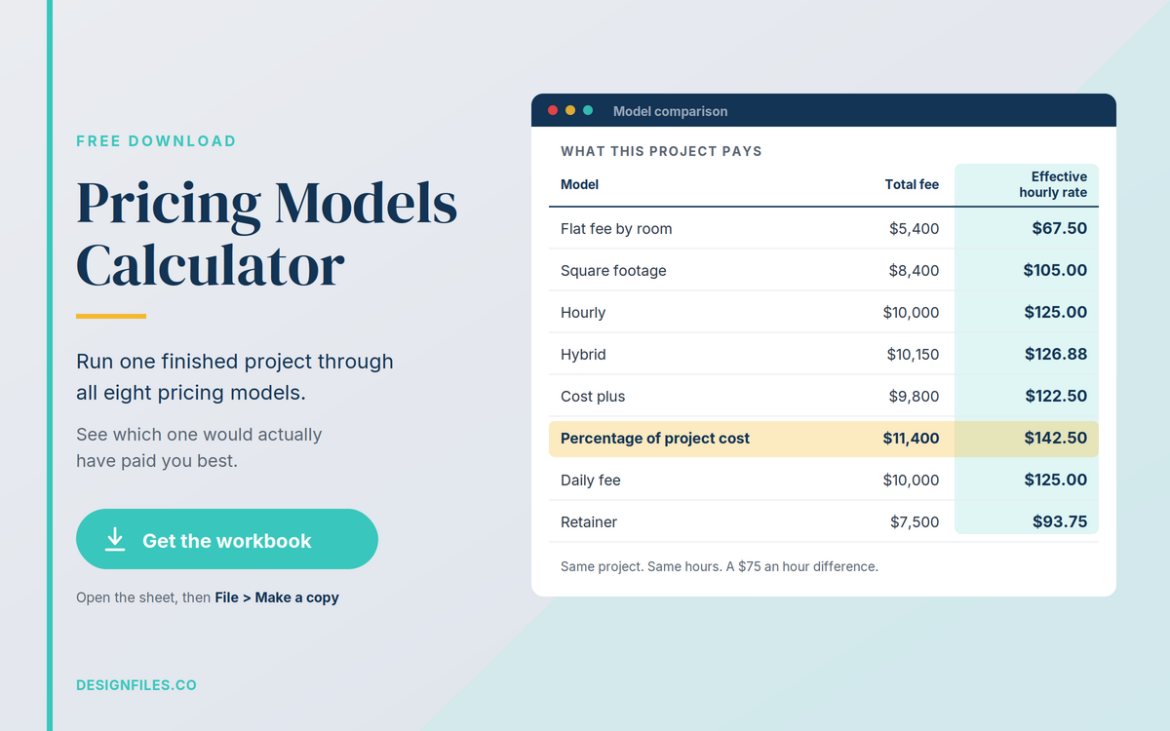
Run your last project through all eight models
You can read about eight models and still not know which one suits you. Which one would have paid you better on the job you finished last month? So we built the thing that answers that.
The free pricing workbook takes one completed project. Rooms, square footage, the hours you actually worked split between design and implementation, your rate, furnishings spend, and total project cost. It returns your fee under all eight models, side by side.
Look at the effective hourly rate column. That is the one that tells you whether your install weeks are being paid for.
A second tab splits the same project into a hybrid structure, so you can watch what happens to your rate as the install runs long. A third works your hourly rate out from your costs, if you have never done that. It asks for the salary you want to pay yourself, which the example sets at $75,000. Treat that figure as your salary rather than your total income. Most owners top it up with profit draws once the business is covering itself, so the field is a floor rather than a ceiling.
One honest caveat. A single project is a sample of one. Run three or four, and include the one that felt worst.
5 signs it is time to change your pricing
There’s more to establishing an interior design pricing strategy than fee structures. You also have to know how much to charge—and when it’s time to raise your rates. So, how do you know when the time is right? Here are 5 signs.
1. You haven’t changed your pricing in more than a year
Sticking with the same pricing structure for an extended period without adjustments will not accurately account for changes in your business costs, market value, or the quality of your services—not to mention, inflation!
2. You’ve upgraded your services and offerings
Most interior designers I know are constantly investing in improving their skills, expanding their service offerings, and enhancing the overall client experience. Your pricing should reflect this increased value.
3. Demand is high and your availability is limited.
A surge in demand for your services, coupled with limited availability, is a surefire sign your expertise is highly sought after. This is the ideal time, economically speaking, to increase your rates.
4. Your peers are charging more
Keeping an eye on the interior design pricing strategies of your competitors can provide valuable insights into market trends and standards. If you notice your industry peers are charging more for similar services, it’s a sign you need to revisit what you charge.
5. You’re resentful
If you’re resentful or undervalued, you’re on the fast-track to burnout. Your pricing should not only cover your expenses and time, but also allow you to feel fairly compensated for your efforts. If you find yourself harboring resentment towards your clients or the work you do, it’s time to reevaluate your pricing model to ensure it reflects the value you bring.
This workshop is built around exactly this decision. Raising your prices without losing the clients you want to keep.
How to test a new pricing model without losing clients
Testing new pricing strategies is a great way to determine what works best for your business model and client base. Here are 9 steps to follow in order to effectively test new pricing models:
Step 1. Identify key metrics
Before implementing any new pricing strategy, establish clear metrics to measure its success. These metrics could include conversion rate from consultation, revenue generated, client satisfaction levels, project completion time, and overall profitability.
Step 2. Segment your clients
Divide your client base into different segments based on factors such as project size, scope, budget, and preferences. This segmentation will help you understand which pricing strategy might be most suitable for each segment.
Step 3. Start testing
Choose a small sample of clients or projects to test your new pricing strategy. This will allow you to assess its feasibility and effectiveness without committing fully.
Step 4. Compare and contrast
Run the test alongside your existing pricing strategy for a defined period. Compare the performance of both strategies based on the identified metrics. Look for differences in revenue, client satisfaction, project outcomes, and other relevant factors.
Step 5. Gather feedback
Throughout the testing phase, actively seek feedback from both clients and your team members involved in project delivery. Understand their perspectives on the new pricing structure, including any challenges or advantages they observe.
Step 6. Adjust and iterate
Based on the insights gathered during the testing phase, refine the new pricing strategy as needed. Continuously iterate based on feedback and performance data.
Step 7. Monitor long-term impact
After implementing the new pricing strategy more broadly, continue to monitor its impact over the long term. Track how it influences client acquisition, retention rates, profitability, and overall business growth. Be prepared to make further tweaks as necessary.
Step 8. Seek expert advice
Consider consulting with industry experts or seeking mentorship from experienced interior designers. Their insights and guidance can provide valuable perspectives and help you avoid common pitfalls. Join DesignFiles’s Facebook group with 11K+ interior designers.
Step 9. Stay flexible
As we all know, the interior design industry is dynamic, and bound to evolve over time. Stay flexible and be willing to adapt your pricing strategies accordingly to ensure your continued competitiveness in the market.
What interior designers actually earn
For interior designers running their own businesses, the ceiling is genuinely high. It also sits further away than most salary articles suggest, so here are the real numbers first.
The median annual wage for interior designers was $63,490 in May 2024 (BLS, 2024).
That figure covers employed designers across all industries, which is exactly why it should not set your expectations. It describes people on payroll, not people running practices.
The average salary across the profession was $71,430 in 2024, up 2.1 percent over 2023 (ASID, 2025).
Owning your business changes the maths entirely. You are not capped by a salary band. You are capped by your pricing model and how many projects you can run well at once. Plenty of self employed designers clear six figures in take home income. Plenty bring in multi six figures, working solo or by scaling a firm.
Two things sit downstream of this. Paying yourself from that revenue is its own skill, covered in how to pay yourself. Setting the actual rate that gets you there is covered in how to price your interior design work.
16 ways to earn more from the work you already do
Ready to not only grow your income but protect it? Here’s what you need to do.
1. Track and forecast your income
You need to not only track your revenue for tax purposes, but for your own uses as a business owner. When you track your income, you also have more data for accurate forecasts and projections.
Megan explains the process like this: “Plot that out for as far forward as you can. What money is going out the door for my employees, for my overhead, for shiny objects, for experiments, for products, for taxes, for marketing, for all of these things, and when? By doing this we can get to the bottom of how much cash will be produced in what time period and what that cash will be used for.
So before the revenue even comes in the door you’ll know:
- What is being used for overhead
- What is being used for marketing
- What is being used to pay yourself,
- What is being used to protect the business
- What is being used to get you towards your personal goal.”
As a fractional CFO, this is the exact process Megan uses with all her designer clients to help them visualize the revenue coming in and how they can use it to better grow their business.
2. Charge for consultations
Charging for consultations. Should you do it or not? Ultimately the decision is yours but when we asked Nancy Quinn her answer was a flat out YES. Charging for your consultation ensures that you get paid for your time. You can do a short, free 15-minute discovery session in order to sell your consultation offer.
“Whether they move forward with you or someone else or do it themselves, what you’ve shared with them is valuable, so you should get paid for that. And then there’s a lot less resentment too,” says Nancy.
For the three consultation formats and what each one should cost, see what to charge for consultations.
3. Always track your hours
Whether you’re charging flat rate or hourly, you should always track your hours. Otherwise, you’ll have no way of actually calculating how much time you spend on projects and whether or not your fees are high enough.
“I know everyone hates tracking their hours, but, sorry, you need to track your hours,” says Nancy. “I think where people get hung up is they feel like they have to do it with perfection. A really close estimate is good enough, as long as you’re being fair to your clients.”
If you need a little help staying on top of your hours can use DesignFile’s time tracking feature to make it easy.
4. Get comfortable talking about money
“Get really, really comfortable talking about money with your clients. If you’re starting a proposal and you’re feeling like, I don’t want to talk about the money – you need to work through that,” says Megan. “We want to talk about money as freely and openly as if we were talking about our kids.”
When her interior designer clients get upset that their clients are asking questions, Nancy reminds them, “They have the right to ask questions. It’s their money. And it’s our job to answer them without getting upset.”
To get to that level of comfort, you need to practice:
- Practice with leads and clients – The more you talk about money, the easier it will get. There’s simply no way around the fact that for some business owners, it takes dozens of conversations with leads and clients over a couple of years in order to get really comfortable with stating prices.
- Practice with business owner friends – Talk about money with your friends who own businesses. Talk about your prices, when you plan to raise them, and why.
5. Work on your money mindset
Women in particular often need to do a lot of money mindset work, because we tend to focus on being of service and pleasing others more than boosting profits.
There are lots of different formats of money mindset work. You can seek out help and resources from trusted friends and community members, or check out popular books like Money, a Love Story and The Soul of Money.
6. Take all payments upfront
Always take payment for your services upfront. This includes consultations, design fees, and the cost of any products you’ll be ordering.
“I’ve never come across a really successful designer that bills in arrears,” says Megan Dahle, CFO for interior designers. “It’s an authority position to demand your money upfront and people respect it. If you frame it correctly, you stand in your power behind it, and you’re confident in it, then clients see it as just the normal thing.”
When using Nancy’s hybrid model, you should also take payments upfront for bulks of hours. So, you would charge for the design fee upfront and then when it’s time to move onto managing implementation, you should estimate how many hours that will take and bill for some or all of those hours upfront as well.
Nancy explains that you can say something like this to your client, “I’m estimating about 20 to 30 hours to order, track, handle any damages, get it delivered to your house, get it placed, so let’s start with 20 hours. You’ll pay in advance, and I work backwards from there. I will give you a report every other week on how much time has been used.” Nancy recommends charging for all of the estimated time, unless it is a very big project. In that case, you can break it down into two to four chunks.
7. Increase your profits from products
You should never feel guilty about marking up products that you recommend to your client. Just because you are making money as a service provider does not mean you can’t also earn a profit on product recommendations. “There’s no such thing as double-dipping. Your margin on your furnishings is for your years of education or self-education, keeping up with your product library, with all your reps, all the latest trends, and the quality of the furnishings. Your project management hourly rate is for any time your hands, your feet, or your eyes are doing what a client would have to do if you didn’t exist. It’s not double-dipping. It’s two separate profitability streams that you’re entitled to.”
Not only are you entitled to earn money from product recommendations, but you also can find ways to increase your profits from these products.
Here are some of Nancy’s top tips:
- Don’t divulge your markup. You don’t need to mention this in your contract, your website, your proposal, or anywhere else.
- Keep working on sourcing. Continue to speak with other designers about great companies that offer profitable trade products.
- Never feel pressured to pass on your discount. You deserve to get paid for your expertise when it comes to choosing products.
- When asked about how you charge for products, simply say, “I do my best to keep my prices at or under retail.” You don’t need to explain any further.
- Aim for a 35% profit margin on products at the very least. If you can get stocking dealer prices, you can push that all the way up to 70%.
8. Don’t discount your virtual services
Designers tend to default on discounting their virtual services. But that isn’t necessary. And it certainly shouldn’t be done without cause.
“What I teach is virtual design, which is not eDesign, meaning, you really don’t have to change your prices at all,” says Nancy. “You’re still going to have that relationship with the client. If you want to discount slightly because you’re not traveling, that’s up to you. But your hourly rate is your hourly rate. For your design phase, you’re going to be doing all the same things, so why would you price it any differently?”
9. Don’t offer volume discounts
You also don’t need to offer volume discounts. Meaning, if someone wants to design four rooms with you, you don’t need to offer them a discount for doing more than two rooms. “Don’t feel like you have to discount says Nancy. “Clients hire you because they love your work. They’re not hiring you because you extended a 10% volume discount.”
10. Calculate your expected ROI before investing in new business expenses
How can you be sure that you’ll get ROI from a business expense? You can never be completely sure, but you can be smart about it.
“The missing question that people forget to ask is when. We ask how much all the time, but not really when. So if I’m going to invest $5,000 in a program and I expect a $20,000 return from what I learn in a program, when do I expect to see this return?” explains Megan.
To put this tip into practice, write down your business expenses as if they were experiments. Log how much you’re spending, what impact you expect that to have (in terms of money earned, time savings, or something else), and when you expect to see that result.
Megan offers this example, “I’m going to try this piece of software and I’m going to come back in two months and see if it did what I thought it was going to do.”
You can even write in your calendar to check the result, or make it part of your monthly expense review process to look back at your log of experiments. If something isn’t working, cut it.
11. Don’t scale and hire just because
It’s easy to attempt to scale our businesses simply because we think we’re supposed to. But is that really what we want? And if so, is now the right time?
“Don’t necessarily be scaling because everybody else is doing it,” says Megan. “Some people even scale beyond profitability because their expenses are rising too fast. Find that sweet spot for yourself. If you want to grow and you know you need to hire someone to help you, make sure that you are figuring out how much revenue that person can contribute to the business and when. How long is it going to take them to get up to speed?”
12. Monitor your fixed and variable costs
“There are two types of expenses,” says Megan. “You need to be acutely aware of your fixed versus variable costs, and keep your variable cost percentage as low as possible.”
Your fixed costs occur no matter how many clients you take on. These are things like your website hosting, your bookkeeper’s fee, and your health insurance premiums. Your variable costs, however, are directly tied to projects. So, if you have a new consultation on the other side of town, the cost of gas is a variable cost tied to that appointment.
When it comes to variable costs, you want to keep them low so that your projects are profitable. And for fixed costs, you want to watch that they’re not eating into your profits during slower months.
13. Calculate your profitability per project
You should aim for 40-60% profitability on every project. “Imagine if you had a $10,000 job and you’re making $6,000 on that and $4,000 is your cost,” says Nancy. “That’s the sweet spot and you can get there. It’s doable.”
For each project, you’ll want to calculate how much time you spent on the project, how much time your team spent on the project, and what purchases you made. The more you track these details, the better you’ll be at estimating time and costs for future projects so you can be sure to reach that profit sweet spot.
14. Always have a pre-defined purpose for your revenue
“Ultimately your business is meant to serve a purpose in your life and people lose track of this, especially when they’re comparing themselves to other businesses,” says Megan. “And so the first thing that I do with my clients is figure out their real goals behind the business goals. What does it mean for you personally, to be able to bring home $10,000 a month? What are you going to do with that money?”
When you have a clear and defined use for your revenue, like saving for a vacation home or a child’s college fund, you’ll be less tempted to spend it on unnecessary or ill-timed expenses.
15. Charge what you’re worth even if you’re just starting out
Depending on where you live, $100 per hour should probably be the lowest starting point. This is the rate you’ll use to calculate your flat rates and to charge for project management if using the hybrid pricing model. “If you have the confidence to start at $150 or $200,” says Nancy, “then that’s where you start.”
Sometimes designers are worried about what clients will say if they have high prices right from the get-go. But Nancy has a mindset solution for this. “This is a mindset issue. You are going in with fear that they’re going to ask you. And if they do ask you, you say, ‘I decided to set up my pricing from the beginning to allow me to stay in business long term, as opposed to struggling the first couple years, and then being afraid that I wouldn’t continue to be able to be here for you today.’ There is no shame in making the money you deserve to make.”
16. Raise your prices if you feel resentful
When should you raise your prices? You can certainly do it before you feel resentful, but resentment is a good sign that it’s definitely time.
“There are clients who just want to shop West Elm, Pottery Barn, and you know what, if that is a service you offer, then offer it without resentment, and make sure that your pricing on your design fee is making you enough money to make you happy,” says Nancy. “If it’s not making you happy, then you’re not making enough money. If you’re getting resentful, you’re not making enough money. If you’re at that point, you have to look at your business model and either add services or change the pricing model.”
And if you have clients that prefer to do the shopping themselves, consider using affiliate links so you can earn a little extra on every purchase.
Start with the phase that is costing you
Go back to the last project that felt unprofitable. Do not look at the client, and do not look at your speed.
Look at which phase was priced wrong. It is almost always the one where somebody other than you controlled the calendar.
Open the pricing workbook and run that project through all eight models. Ten minutes, and you will know whether the structure was the problem.
Once you know which model fits, turn it into an offer clients can say yes to. Our Ultimate Profitable Packages Guide walks through exactly that. For the proposal itself, read our guide to interior design proposals.
Then prove it worked. DesignFiles shows margin per line item and profit per project. That is the honest way to find out whether your new model did what you hoped. Start free, no credit card required.
Interior design pricing models FAQs
There is no single best one, and any guide that names one is oversimplifying. For residential work, a hybrid usually wins. Flat fee for the design phase, hourly for implementation, and cost plus on anything you procure. Match each phase to how predictable its hours are. That principle holds whether you run a solo practice or a small firm.
Both, on different parts of the same project. Use a flat fee for work with defined deliverables and a clear finish line, like a concept phase you have run many times. Use hourly for installation, contractor coordination, and anything where the timeline depends on other people. Estimate the hours upfront and bill in advance rather than in arrears.
Yes, and it is the norm among established designers. A single project might carry a flat design fee, an hourly rate for install oversight, and cost plus on furnishings. What matters is that each fee is stated clearly in your contract and your proposal. Clients rarely object to multiple structures. They object to surprises.
Cost plus means you buy furnishings at trade pricing and sell them to your client at your cost plus an agreed percentage. That percentage compensates you for sourcing, vendor relationships, and order management. It runs alongside your design fee rather than replacing it. Cost plus works best when you handle full procurement, and does very little for a design only practice.
DesignFiles offers the tools, content, and community that interior designers need to succeed! Sign up for DesignFiles.

![How Much to Charge for Interior Design [With Free Calculator]](https://blog.designfiles.co/wp-content/uploads/2024/08/charge-for-interior-desig-services-image-16x9-1-768x432.jpg)