
You presented on Tuesday. Your client loved the room. Then she said she wanted to sit with the sofa for a few days.
Three weeks later, that sofa is still unconfirmed. The vendor price has moved. Your install date is now a guess. You have spent six unbillable hours chasing a single decision.
That gap between shown and signed is where design projects quietly lose money. It is also where your capacity disappears. Every project stuck in limbo takes up room you could be giving a new client.
The fix is not a firmer follow-up email. It is a better interior design approval process, built on decision points you plan instead of moments you react to.
Designers bring me revision problems far more often than pricing problems. Every one of those conversations starts at the presentation. The cause is almost never there.
More than 6,000 designers now run their projects on DesignFiles, covering 682K projects to date.
This guide covers the five points where approval should be captured, how to run revision rounds that actually end, and the language you can hand a client so none of it feels rigid. For the wider workflow these checkpoints sit inside, see our interior design process checklist.
Table of Contents
Where approvals actually break down
You think you have a client problem. You probably have a checkpoint problem. The moment things went sideways almost always predates the day you presented.
The yes that nobody wrote down
She said yes on site. You both remember it differently now.
Verbal approvals are the easiest failure to fix and the one designers avoid fixing. It feels awkward to formalize a decision you made together in a real conversation. Then the invoice goes out, and suddenly you are negotiating your own memory against hers. This is a documentation gap. Treating it as a trust issue is exactly why it never gets solved.
Feedback scattered across four channels
A yes lives in an email thread. A question came by text. A comment sits on a PDF. One change was mentioned on a call.
The cost is not the time you spend hunting. The cost is that nobody can say with certainty what the currently approved design is. You become the only person who knows. That is precisely what stops you from delegating a project or taking a week off.
Approval asked for before the client can picture it
Here is the one you will not expect. A client who cannot see the room will stall, and stalling looks identical to indecision.
Asking someone to approve a list of products is asking her to approve something she cannot picture. She is not being difficult. She is being careful about a lot of money. Show her the room before you ask about the pieces.
A designer in one of my workshops was averaging four revision rounds on every full-service project. When we walked her process backward, the pattern was obvious. She was presenting furniture selections before her clients had ever approved a layout. She moved layout sign-off ahead of sourcing, and her rounds dropped to one.
The five approval checkpoints every project should have
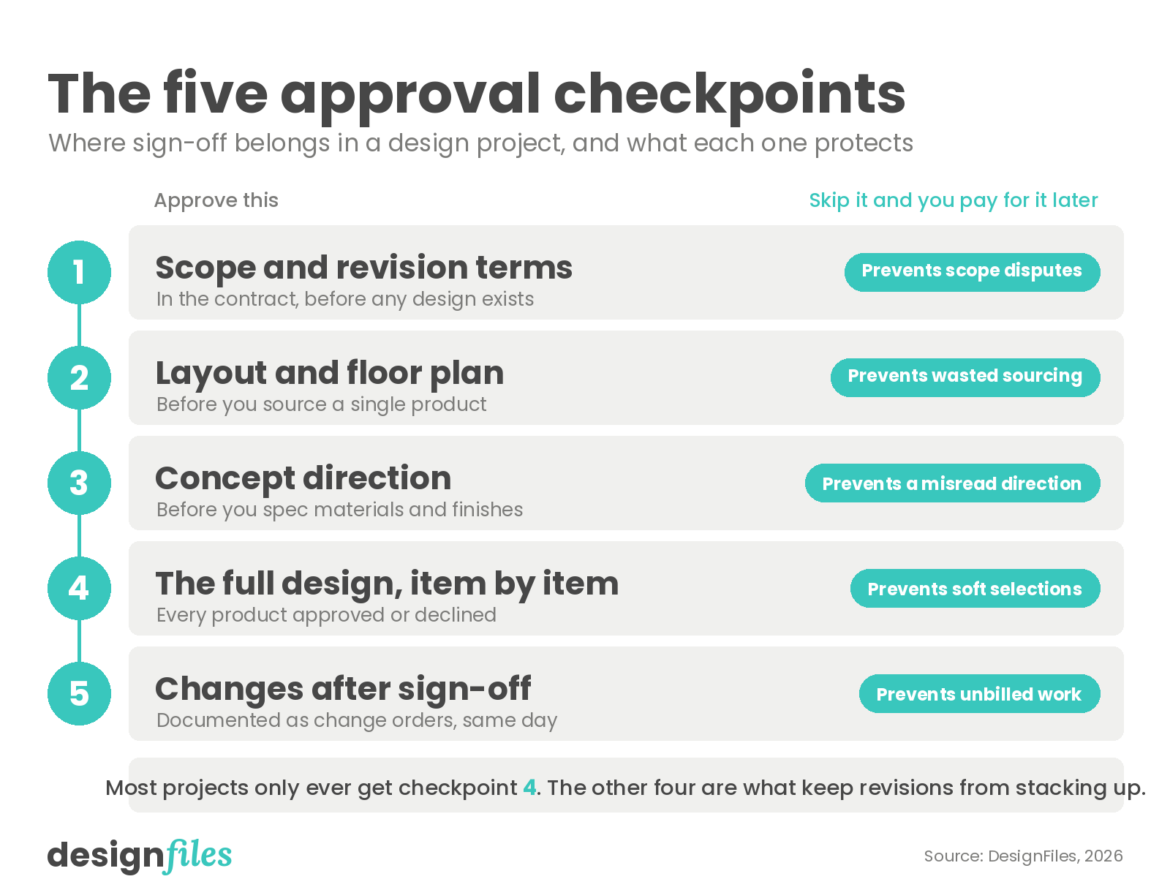
Right now, one approval point is doing the work of five. Your presentation is carrying the contract, the layout, the concept, the selections, and every change that comes after it.
These five run in sequence. Each one protects the checkpoint that follows it, which is why skipping one shows up as revisions later.
Checkpoint one: scope and revision terms, approved in the contract
Your first approval happens before a single design exists.
The contract sets how many revision rounds are included and what happens when your client wants more. Spell out four things: rounds included, the deadline for submitting them, your rate beyond that, and what falls outside scope entirely. Our guide to building an interior design scope of work covers the full document.
Checkpoint two: layout and floor plan, approved before you source
Layout is the cheapest thing to change early and the most expensive thing to change late.
When a client decides on presentation day that she wants two chairs instead of a sectional, your sourcing is void. Hours of it. This checkpoint does not require a meeting. A shared plan, a comment box, and a return date will do. A 3D floor plan makes the layout legible to someone who has never read a drawing, which is the whole point.
Checkpoint three: concept direction, approved before you spec
Not every project needs a concept phase. Say that plainly to yourself before adding one.
It earns its place on high budgets, on adventurous directions, and with clients who have never hired a designer. You are confirming mood, palette, and boldness before you spend hours sourcing to them. The ask is simple. Does this direction feel right before selections begin?
Checkpoint four: the full design, approved item by item
A blanket yes on a presentation gives you nothing to point at when one piece gets questioned in October.
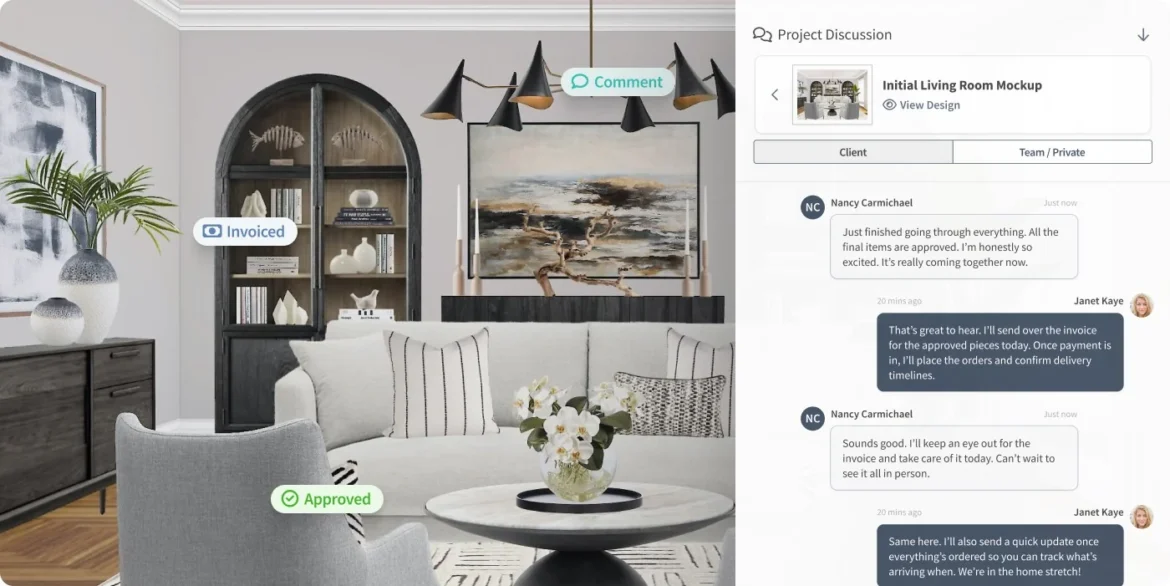
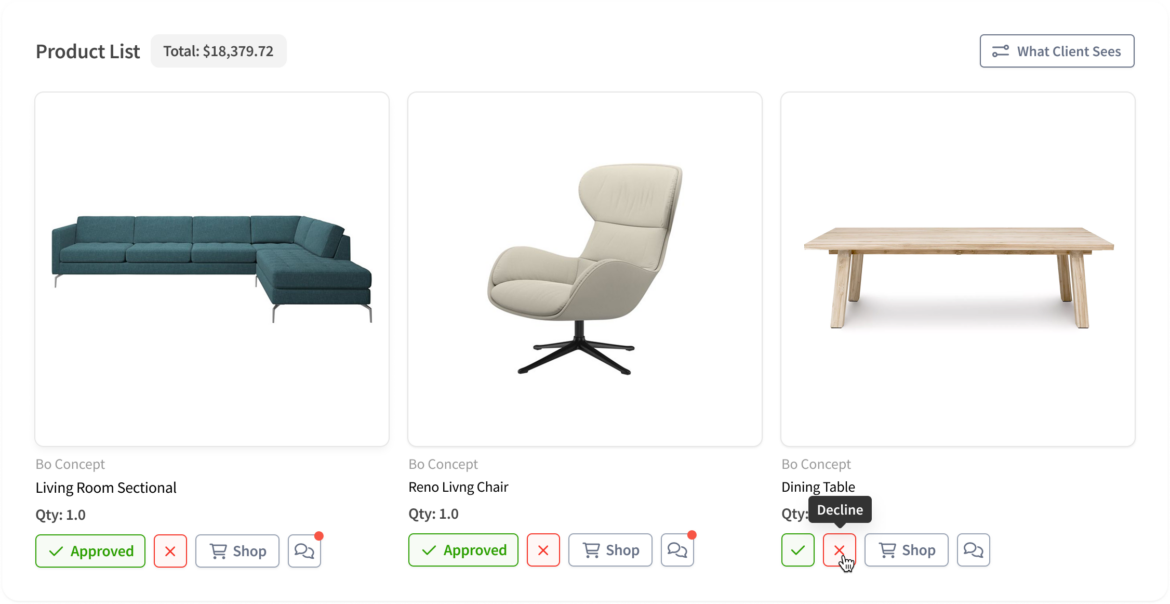
Every product needs its own approval or decline. Item-level decisions also hand you a clean procurement handoff instead of a puzzle. Inside the moodboard editor, clients approve or decline individual products, and your spec list builds itself as you design.
Checkpoint five: changes after sign-off, approved as change orders
Something will change after approval. Plan for it rather than absorbing it.
A change order captures what changed, who asked, the cost impact, the schedule impact, and written confirmation. Send it the same business day. Do not start the work until the confirmation lands. Then tell your own team, because the fastest way to eat the cost twice is having someone order the original spec.
Designers ask how to get clients to stop revising. The better question is which decision you asked for too late. Move the sign-off earlier in the sequence and most of the revisions disappear on their own.
How the revision process should actually run
Your client came back with changes. Nothing has gone wrong. Interior design revisions are a normal part of collaborative work, and a process that pretends otherwise will fail the first time it meets a real project.
What matters is whether your revision process has edges.
Decide what a round includes, then say it out loud repeatedly
The number of rounds matters far less than your definition of one.
Define a round as all feedback, collected once, submitted by a deadline. Then repeat that definition in the contract, the welcome guide, the presentation confirmation email, and again when revisions open. Repetition reads as guidance, not rigidity. Clients generally feel safer knowing the rules than guessing at them. Our post on how to write a design contract has the clause itself.
Collect feedback once, in one place, on a clock
Feedback arriving in pieces across ten days is not one round. It is ten interruptions.
Open the round. Give a specific return date. Hold it. Keep the comments attached to the design itself rather than buried in a reply-all thread, so every note sits beside the thing it refers to. The deadline protects your client too. Delayed decisions move install dates and vendor pricing, and she would rather hear that now than in November.
Re-present against the original decision, not from scratch
This is the step designers skip, and it is where projects lose their shape.
When you present round two, show what was approved, what changed, and why. Anchoring to the previous decision stops the slow drift that leaves a design unrecognizable by round three. Try something like this: you approved the walnut credenza, you asked for a lighter finish, here is that same piece in white oak.
Price the work that falls outside the rounds
Unbilled revisions are the quietest margin leak in your business.
Pick your approach now: hourly, a flat fee per additional round, or a per-item reselection fee. Put a number on it before the project starts, because deciding mid-project always favors the client. Budget pressure is real on both sides right now, which makes a clear number more useful, not less. According to ASID’s 2026 Trends Outlook, nearly three-quarters of firms report raising prices to offset rising costs.
Designing presentations that get approved the first time
The fastest way to reduce revisions is to make your design easier to say yes to. That work happens before you ever ask the question.
Show the room before you show the pieces
Your client approves spaces. She does not approve spreadsheets.
A rendering or a furnished 3D view lets her react to the whole room instead of second-guessing one chair in isolation. This matters most when your design pushes past her comfort zone. Seeing it resolved is what makes the risk feel survivable, and it is why a bold scheme presented flat gets cut down to beige. Designers have created 4M designs on the platform, which is the scale behind this pattern.
Make one recommendation and show your reasoning
Six options transfer your job to your client.
She hired you so she would not have to choose. Lead with your recommendation and attach the reasoning: why this piece, for this room, at this budget, with this lead time. Some designers do well presenting two or three curated options at different price points, and that works when a client genuinely enjoys deciding. Read the client in front of you rather than applying one rule to everyone. What does not work is handing over a menu and calling it service.
Put the specs where the decision happens
She cannot approve what she cannot evaluate.
Dimensions, finish, lead time, and the all-in price belong beside the image, not in an attachment she has to open. A spec list generated from the design itself also removes the copy-paste errors that turn into disputes at delivery. Detail is what converts a soft reaction into a real commitment.
I worked with a designer who added lead times to every product on her boards. Her approval turnaround went from two weeks to four days. Her clients were not slow. They were waiting on information she had not given them.
Our guide to interior design presentations covers slide order and structure, and you can see the full toolset on our client presentations page.
Making approvals easy to give and easy to find
Where do your interior design approvals actually live? If the honest answer is four places, that is the next thing to fix.
One place for every comment, decision, and yes
Stop chasing approvals and start reading them.
When comments attach to specific products and designs, you get a running history of what was approved, declined, or flagged for revision. That history does more than save you time. A team member can pick up the project without calling you, and a disagreement about what was agreed has a record instead of two memories. Our client communication portal is built around exactly that.
Control what the client sees before you send
Half of approval friction comes from showing too much.
Source links, your cost, and your markup do not belong in a client-facing view. Preview the client version of every file before it goes out, and release documents when you are ready rather than as you build them. A controlled view makes for a calmer client, and a calmer client decides faster.
Turn the approval into the next document
A yes should become a quote, an invoice, or a purchase order without anyone retyping a thing.
The gap between approval and paperwork is where projects stall and errors sneak in. Every hour you spend converting an approval by hand is an hour you cannot bill to anyone.
Treat every approval as the start of a document, not the end of a conversation. If a client’s yes does not immediately become a quote or a PO, you will spend the next week rebuilding it by hand.
What clients should expect from the approval process
This section is written for your client. Lift it into your welcome guide, or send her the link before your first presentation.
What you are approving at each stage
Your approval happens in stages, and each stage locks in something different. First the plan, then the direction, then the individual selections, then any changes after that.
This exists to protect your budget. Nothing gets ordered, and no money gets spent, on something that later has to be undone.
How long you have, and why the clock matters
Each round of feedback comes with a window, usually about a week.
Vendor pricing changes. Stock runs out. A two-week delay on one decision can push your install by a month, because everything downstream is scheduled around it. Send all of your thoughts at once rather than in pieces. You will get a better result and a faster one.
What counts as a revision and what counts as something new
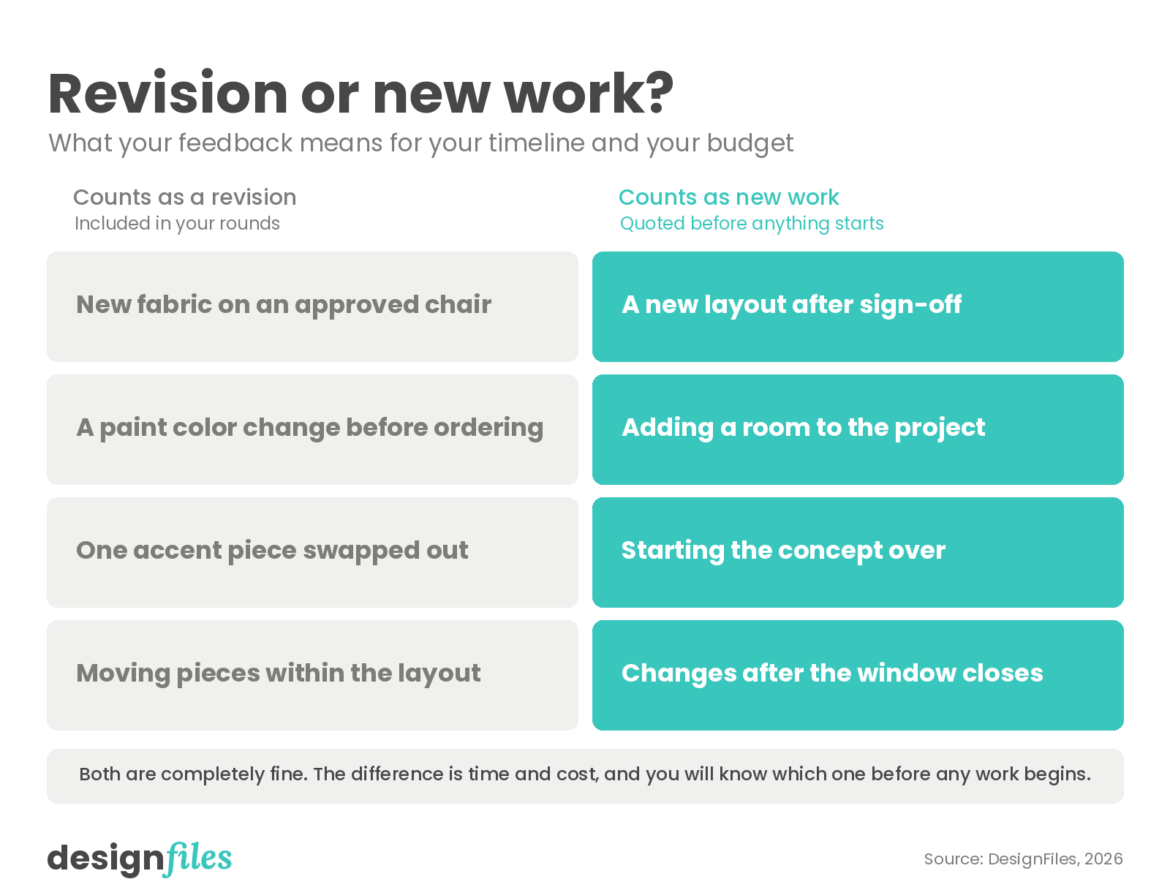
Swapping the fabric on an approved chair is a revision. Deciding to change the room layout after selections are approved is new work.
Both are completely fine. The difference is time and cost, and your designer will tell you which one you are asking for before any work begins.
Bringing it together
Revisions are the symptom. Checkpoints are the cure.
You do not need to add five meetings to your process. You need five moments of clarity, and most of them can happen asynchronously while you work on something else.
Pick the one checkpoint you are currently missing. Add it to the next project you start, not the one you are mid-way through. Then watch what happens to your revision count on that project compared to your last.
Every designer I have watched get her time back did the same unglamorous thing first. She stopped asking for approval in conversation and started asking for it in writing, at the same five moments, every project.
For how these checkpoints fit into the full arc of a job, read our guide to the interior design project management process. Ready to keep every approval in one place? DesignFiles is the top-rated solution on Capterra for small firms and solo designers. Try DesignFiles for free for up to one project at a time.
Interior design approval FAQs
Two rounds works for most full-service packages, and one is common for e-design. The number matters less than your definition. State that a round means all feedback collected once and submitted by a specific date. Put your rate for additional rounds in the contract before the project begins, so you are never negotiating it mid-project.
Five checkpoints: contract and revision terms, layout sign-off before sourcing, concept direction before specifying, item-by-item approval of the full design, and change orders for anything that shifts after sign-off. Each one should produce something written. A verbal yes at any of these stages leaves you with nothing to reference later.
Document the request, then confirm the cost and schedule impact in writing before you start. Reference the original approval so the change is visible as a change. If it falls outside your included rounds, quote it. Clients rarely object when the policy was explained upfront and applied consistently every time.
Treat them as the start of an approval, not the approval itself. Draft the change on your phone while you are still standing there, read it back, then send written confirmation the same business day. Do not begin work until she replies. Memory fades quickly, and a written record protects your client as much as it protects you.