You have restyled your own living room at least twice this year. Friends send you photos of their empty walls and ask what to do. Someone asked where you found your coffee table, then went and bought it.
Somewhere in there, a quieter thought arrived. People might pay for this.
They will. The tricky part is deciding what you are actually selling, and the internet is not helping. Search for how to start an online home decor business and you will find guide after guide about sourcing inventory, negotiating with suppliers, and arranging shipping. That is a product business. It is a perfectly good one, and it is not your only option.
This guide covers the other path. You get paid for your eye, your sourcing, and your styling. No vases live in your garage. The demand is there to support it, too. The global home decor market was valued at USD 802.26 billion in 2025. It is projected to reach USD 1,299.88 billion by 2034.
In six years of running workshops for designers, the people who launch fastest are never the ones with the best taste. They are the ones who decided what they were selling before they built a website.
Below you will find the nine steps, how to price your packages, and the decor trends worth building a business around through 2030.
Table of Contents
What an online home decor business actually offers
You sell taste, sourcing, and styling. Clients pay you to choose the rug, the lamps, the art, and the throw pillows, and to tell them how it all works together.
That gets paid for in three ways, and you can use all three at once.
The first is your service fee, which covers the design work itself. The second is markup on products you source and purchase on a client’s behalf, which is standard practice and worth understanding early. Our guide to marking up products as a designer walks through the numbers. The third is affiliate and commission income, earned when a client or a follower buys through your links. There are affiliate programs built for designers and decorators worth joining early. That third stream is what makes decorating work so well online, because your Instagram audience can generate revenue without ever booking you.
One quick fork in the road. If you want to include floor plans, measurements, and layout, e-design is the closer fit. Head to our guide to starting an e-design business instead.
Regarding the scope of services, most home decorators select items like furniture, accessories, lighting, artwork, and rugs. They’re knowledgeable in current trends, color schemes, and styling tips. Home decorators are very different from interior designers, who offer space planning and layout design and often oversee renovation projects. Typically, paint selection also falls in the realm of interior design and is not something that home decorators offer.
Where new decor businesses usually get stuck
Your future client can absolutely style her own shelf. She has Pinterest, a Target run, and a free Saturday.
That is the first thing making this harder than it looks. Decorating reads as doable to the person hiring you, in a way that a kitchen renovation never does. You are asking someone to pay for something she believes she could manage herself.
The second thing is that anyone can start tomorrow. There is no license, no exam, no gate. Which is lovely for you right now, and crowded for you six months from now.
Both problems have the same answer. You need a narrow enough focus that a past client can describe you in one sentence, and a point of view visible enough that people recognize your work before they see your name. The next step is where that starts.
How to start your online home decor business
Follow these steps to launch your new business.
Step 1. Pick a niche or style
Before you start setting up your business, you should first pick a style or niche that will empower all of your other decisions.
Some examples of styles include:
- Boho
- Feminine
- Masculine
- Coastal
- Traditional
- Soulful
- Vintage
- Southwestern
- French Country
By choosing a style or two, you can narrow down your branding easier in later steps.
Getting the width right matters more than getting the style right. Too broad and you blend into every other decorator in your city. Too narrow and you run out of people to sell to before you have proof it works.
Here is a test that works. A good niche is specific enough that a happy client can describe you in one sentence to a friend, and broad enough that you can name five potential clients in your own town right now.
One decorator I worked with offered whole home styling to anyone who asked, and spent a year competing with everyone. She narrowed to nurseries and small kids’ rooms, which felt terrifyingly small at the time. Within six months she was being referred by name in local parent groups, because she had become the person for one specific thing.
It’s okay to change your decor aesthetic over time, but it’s better to hone a unique perspective than attempt to satisfy everyone.
Step 2. Name your business
Once you’ve clarified your niche, it should be a bit easier to choose a business name. Unless you’re absolutely certain that you will stick with your niche in the long run, your business name should not match it exactly. For example, if you might move to another geographical region in the future, you should not opt for something like Tahoe Decor. Instead, choose a name that showcases your style while providing flexibility, such as Rustic Retreat Decor.
And of course, you can always do business under your own name.
Step 3. Create a website
The next step is to create a website. Use an easy online website builder like Wix or Squarespace. These platforms offer tons of templates and are generally easier to use than developer-focused platforms like Webflow and WordPress.
At this stage, you’ll need to choose a color palette for your website and create a logo. You can use a logo creator like Tailor Brands or hire a logo designer. Again, make sure that your logo and color palette align with your niche without being too narrow. You don’t want your website to compete with your portfolio, so opt for neutral colors where possible.
Step 4. Choose the right software
I talked to a decorator who was running boards in one tool, invoices in a spreadsheet, and product links in a Google Doc. She lost a sale because a client asked for the source on a light fixture and she could not find it. That is not a taste problem. It is a system problem, and it is the cheapest one on this list to fix.
What you need is narrower than what a full-service designer needs. You need a way to build boards, a way to capture products and pricing straight from vendor sites, a way to turn those selections into a shoppable list your client can actually buy from, and a way to invoice. Procurement, warehousing, and install scheduling can wait, possibly forever.
DesignFiles covers exactly that list. Your boards generate the product list as you build them, the Product Clipper pulls images, dimensions, and pricing from any vendor site, and your packages can sit on your own website taking payment upfront.
Step 5. Set your prices and put the terms in writing
To streamline operations and make costs predictable and transparent, most home decor businesses offer flat-rate packages. You might have different packages for different types of rooms like dining rooms and living rooms. Or you might charge a flat rate for one-room projects, two-room projects, and three-room projects.
To help you determine your rates, head over to Google and research what other home decorators in your niche or local area are charging. Then use DesignFiles to create packages that you can sell directly from your website.
Resist the urge to come in under all of them. A low price does not lower what your client expects, it only lowers what you are paid for delivering it. Competing on price in a field with no barrier to entry is a race you do not want to win. Our guide to interior design pricing packages shows how to build tiers instead.
Then write the terms down. Every package needs a scope covering what is included, how many revision rounds she gets, what happens when she wants a fourth, and when the project is finished. Our guide to writing a design contract has a template.
I have watched more new decorators lose money to a vague scope than to a low price. The number on the package matters far less than the sentence that says what happens when a client asks for a fourth revision.
Step 6. Announce your new business
Now that your digital storefront is all set up and you’re ready to start taking payments, it’s time to announce your business.
Here are some effective ways to spread the word:
- Post on social media: Share the news on all your social media platforms. Include engaging visuals and a link to your website or online store.
- Send an email to friends and family: Draft a personalized email announcing your new venture and send it to your friends, family, and professional contacts.
- Call up friends: Make it personal by calling up friends and telling them about your new business. They’ll appreciate the direct communication and can help spread the word.
- Network at events: Attend local networking events, industry meetups, and community gatherings to talk about your new business.
- Utilize online forums and groups: Join online forums and social media groups related to your industry. Check out our webinar on getting clients from Facebook groups for more.
- Offer a launch promotion: Create a special launch promotion or discount to attract initial customers and encourage word-of-mouth referrals.
- Update your website and blog: If you have a website or blog, make sure to update it with a detailed post about your new business, including the services or products you offer and how customers can reach you.
Step 7. Set up a quarterly marketing plan
Your first few clients will come from people who already know you. That is exactly how it should go, and it is also why month four catches so many new decorators off guard. The personal network gets used up, and there is nothing behind it.
A quarterly plan is what sits behind it. Effective marketing methods for an online home decor business include social media, search engine optimization, publicity, and email campaigns.
Start with one or two, such as Instagram marketing and email marketing. List every task involved, then spread those tasks evenly across the twelve weeks so the work is small and constant rather than urgent and occasional.
For more tips and tutorials to assist you in creating your plan, check out our guide on proven marketing methods for interior designers and decorators.
Step 8. Track every lead from day one
Save the contact details of every person who enquires, starting with the very first one.
Timing kills more decor inquiries than price does. Someone reaches out in March while she is still saving for the sofa, goes quiet, and would say yes in September if you were still on her radar. Three, six, or nine months later, the moment arrives.
A Kanban board is fine to begin with. As you grow, look at a proper system: our guide to CRMs for interior designers compares the options. If your design platform already includes a client portal, your leads and projects can live in one place instead of two.
Step 9. Learn to sell by asking better questions
Good selling is mostly good listening. Your job on a discovery call is to understand the room and the person in it, then point her toward the right service, even when that service is not yours.
Three questions do most of the work. What is this room doing wrong for you right now? What have you already tried? What does finished look like?
Your website sells while you sleep, so keep it current with new portfolio pieces, clear service details, and testimonials. She should already understand the transformation you offer before she books the call.
What actually works for marketing in year one
You do not need eight channels. You need two that suit visual work and a decorator’s schedule.
Pinterest and Instagram come first, and Pinterest is the one most decorators underuse. It behaves like a search engine, which means a shelf styling pin from January can still be sending you inquiries in November. Post real rooms, seasonal refreshes, and before and afters.
Referral partnerships come second. Realtors staging listings, furniture and lighting showrooms, and photographers all meet your client before you do. One good relationship with a local shop owner is worth a month of posting.
Content sits underneath both, doing double duty as portfolio and search visibility. Write up the projects you are already doing. Our guide to digital marketing strategies for interior designers goes deeper on the channels.
Decor trends worth building a business around through 2030
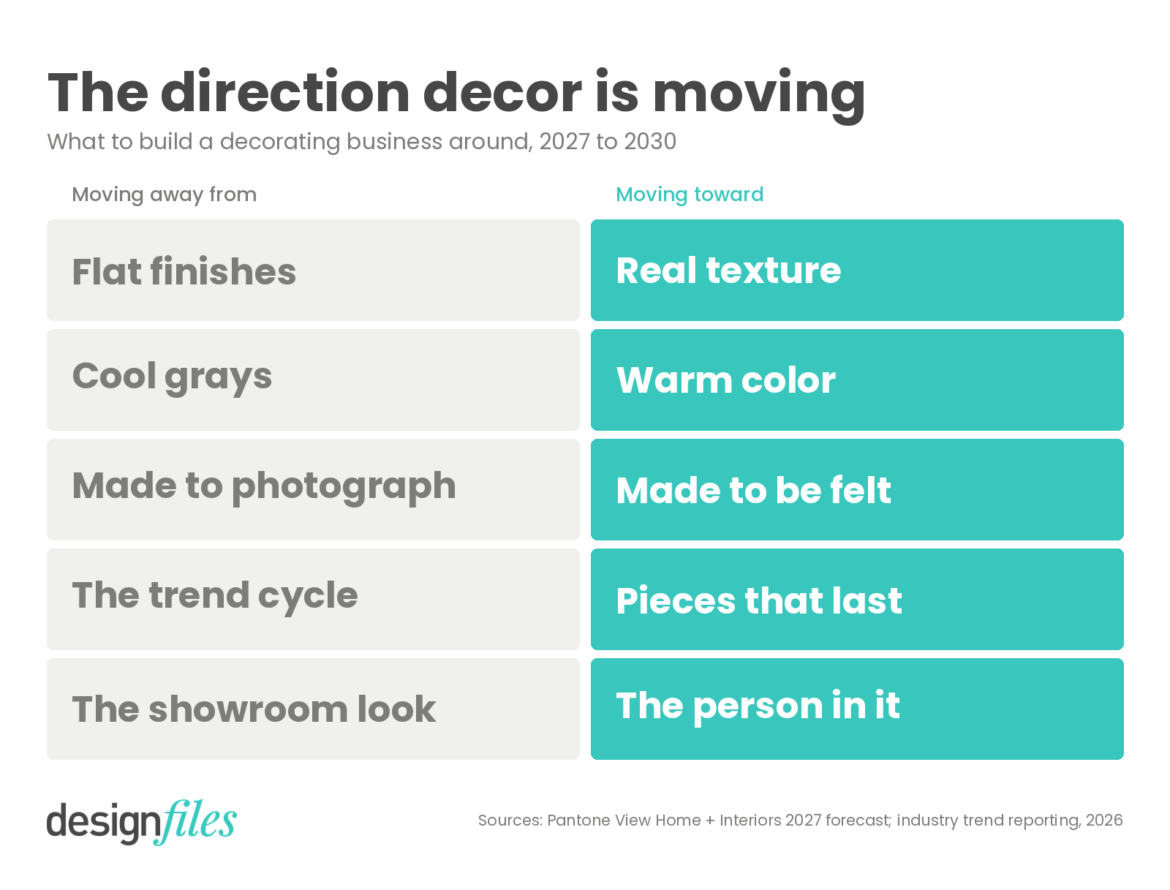
Chasing the aesthetic of a given year is exhausting and expensive. Understanding the direction the market is moving is neither, and it is what you actually build a business around.
Every workshop season I meet someone who rebuilt her whole brand around a trend that was already peaking. Pick the direction, not the year’s aesthetic, and you will not have to redo this in eighteen months.
Here is where decorating is heading, and what each shift means for how you sell.
Sensory design replaces purely visual design
Rooms are being judged on how they feel rather than how they photograph. The Pantone View Home + Interiors 2027 forecast is built around the theme “Sense-Abilities” and organised into seven palettes, revealed at The Inspired Home Show in March 2026.
For you, this rewards the consultation. Clients respond when you can talk about weight, warmth, and texture. It also means a flat board of product cutouts will persuade less than one showing layering.
Warm and saturated colour continues to replace cool neutrals
The grey and greige era is closing. Warm neutrals, earth tones, and confident colour are winning across every major forecast. WGSN and Coloro named Luminous Blue their 2027 Color of the Year.
Check your portfolio for this one. A body of work built entirely on cool minimalism will start reading as dated to clients before it reads that way to you.
Natural materials and real texture over flat finishes
Wood, stone, linen, wool, cork, and living plants are the baseline expectation now rather than a stylistic choice.
This is genuinely good news when you are starting out. Sourcing natural materials well rewards patience and vendor knowledge rather than a big budget, which is a game you can win in year one.
Ways to implement this trend:
- Use reclaimed wood for furniture and accent pieces.
- Incorporate energy-efficient lighting solutions.
- Choose natural materials like bamboo, jute, and organic cotton for textiles and decor items.
- Add indoor plants to various rooms to improve air quality and bring nature indoors.
- Use natural materials like stone, wood, and water features to create a calming environment.
Buying for longevity instead of the trend cycle
Vintage, secondhand, and buy-it-once are all rising, driven by sustainability and by plain trend fatigue.
Sourcing becomes the service here. A decorator who can find the right vintage credenza is worth considerably more than one who can only shop new retail. Price that time honestly, though, because secondhand pieces carry no trade discount and therefore no markup.
Personalization over the showroom look
Rooms that look like a catalog are losing to rooms that look like the person living in them.
This is your strongest argument against a client simply buying a matching furniture set, so make it part of how you sell rather than something you mention once.
Frequently asked questions
Starting an online home decor business is very affordable. Depending on the solutions you use for legally incorporating your business, creating a logo, and building a website, it could cost anywhere from $1,000 to $10,000 to get up and running. You can save money by using AI to create your logo and developing your website yourself with the help of templates.
To start an online home decor business, pick a niche or style that will guide all your decisions. This will help you narrow down your branding and make it easier to choose a business name. Create a website using a user-friendly platform like Wix or Squarespace, and ensure your logo and color palette align with your chosen niche. Finally, choose the right software, determine your pricing, and announce your business through social media, email, and networking.
A home decor business focuses on selling and arranging decorative items like furniture, accessories, and artwork to enhance the aesthetic appeal of a space. In contrast, an interior design business involves creating functional and visually pleasing environments through space planning, paint colors, lighting, and furniture layout, often requiring a deeper understanding of architecture and design principles. Interior designers may also handle renovations and coordinate with contractors, while home decor businesses primarily offer products and styling services.
Three ways, usually at the same time. You charge a service fee for the styling and sourcing work itself. You earn a markup on products you purchase on a client’s behalf. You earn affiliate or commission income when clients and social media followers buy through your product links. That third stream is what lets a decorating business earn from an audience, not only from booked clients.
Home decorating is generally not a licensed profession, which is one reason it is quicker to start than interior design. You will still need to register your business according to local rules, and requirements vary by state and country. Check your own local regulations, and speak to an accountant or business lawyer if you are unsure which structure suits you.
If you want to offer interior design services—but not hands-on installation—check out our guide to starting an e-design business.
And if you’re looking for the best platform for creating shoppable designs and serving clients, check out DesignFiles.