
It is Sunday evening and you are writing another proposal.
Not a new one exactly. A slightly different version of the one you wrote three weeks ago, for a client who wanted almost the same thing. You will send it Monday. She may go quiet, and you will never know why.
Packages fix the specific problem of writing your offer over and over. You build it once, price it once, and put it somewhere people can see it.
Every designer I have watched move to packages says the same thing about month two. The relief was not the money. It was never writing another bespoke proposal on a Sunday night.
This guide covers what goes inside a package and what each type should cost. Then how many revisions to include before it stops being profitable. Then how to build three tiers so the right one sells, and where to put them so people actually buy.
It also includes seven real packages from working designers. Not mockups. Live, published pages you can open and study.
Table of Contents
What interior design pricing packages actually are
Packages are predefined service offerings sold at a set price, instead of an hourly rate or a bespoke quote each time.
Three types cover most of what designers sell.
E-design packages deliver the design remotely. Concept board, floor plan, shoppable product list, a set number of revisions. The client executes it herself.
Standalone consultations are one session where you give direction on furnishings, fixtures, lighting or colour. Sometimes with a written follow-up, sometimes without.
Full service packages cover the whole project, usually priced per room or per square foot, with furnishings billed separately.
Here is the framing that matters, and most articles on this topic skip it entirely. A package is a scope decision with a price attached. The price is the easy half. Designers who lose money on packages almost never mispriced them. They under-defined them.
That is what the rest of this guide is really about.
Why packages beat quoting every project
Flat-rate packages provide clarity for your client and efficiency for you. She understands exactly what she gets and what it costs, which builds trust from the first conversation. You stop negotiating and start delivering.
The bigger benefit is one designers underrate. Publishing your prices means the people who book already know what they cost.
Any designer who has laboured over a long proposal only to get ghosted will understand the relief. No sticker shock. By the time you are on that first call, she knows the price and has largely decided.
That also makes the call itself better. You spend it on her project rather than on justifying a number she is seeing for the first time.
Now the part other guides leave out, because it is inconvenient.
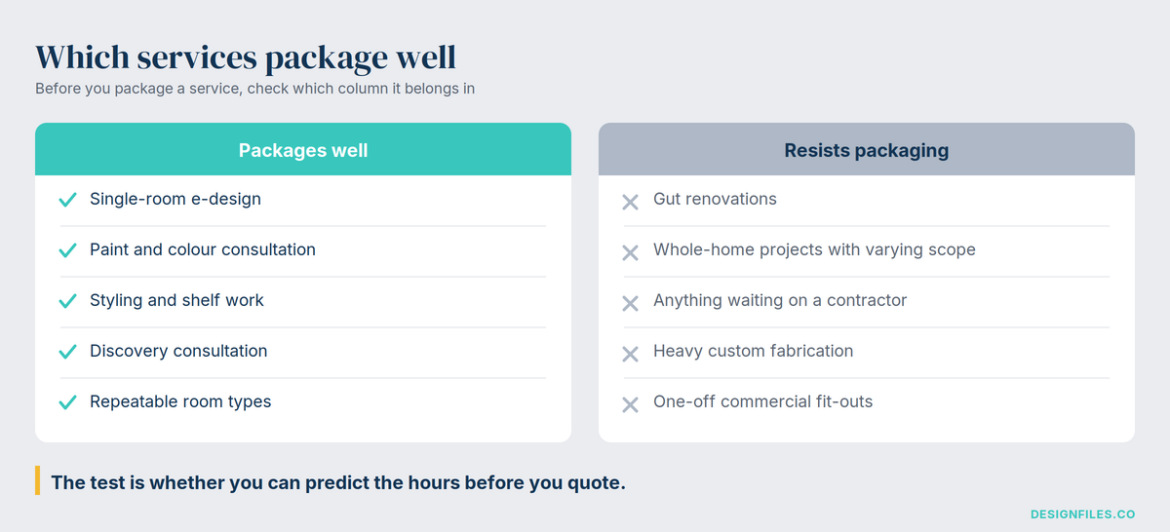
Packages work against you when your projects genuinely vary. A designer doing gut renovations of different sizes will lose money packaging them, because she cannot forecast the hours before she quotes. The same is true of anything that waits on a contractor’s timeline.
The designers I see get the most out of packages are not the ones with the widest range. They are the ones who noticed they kept selling the same three things.
That is the test. If you can predict the hours before you quote, it packages. If you cannot, price it another way.
What to charge for each package
Treat every figure below as a reference point. It tells you whether you are wildly out of step, and nothing else.
Your own number comes from your hourly rate and the hours each package actually consumes. If you have never worked that rate out from your costs, do that first. Our guide to calculating your hourly rate walks through it, and the free calculator does the arithmetic for you.
One more caution. Published pricing data is collected from the buyer’s side, because homeowners are who the aggregators survey. It skews toward larger markets and full service work.
Consultation and mini packages
The entry point. One session, sometimes with a short written follow-up.
Consultation-only and mini redesign packages commonly run $300 to $1,000.
Two things move that number. How long the session runs, and whether she leaves with a document.
Here is the strategic point. This package is not primarily a revenue product. It is a qualification product. It filters out browsers, and it gives a nervous client a low-risk way to work with you once before committing to more.
For consultation pricing in full, including free discovery calls and paint consultations, see what to charge for consultations.
E-design packages
The most commonly packaged service, and where most designers start.
The standard deliverable set is a concept board, a floor plan, a shoppable product list, a set number of revisions, and a follow-up. Pricing is usually per room, and design-only work runs roughly $450 to $1,500 per room.
What drives the spread is deliverable count, more than market. An e-design package with a rendered 3D view and two revision rounds is a different product from a mood board and a shopping list. Pricing them the same is the most common mistake in this category.
Remember that e-design carries no furnishings revenue. Your client buys everything herself, so the design fee has to stand on its own.
Full service packages
The largest, and the hardest to package well, because scope varies most.
Two structures dominate. Per room, or per square foot. Including furnishings, per-room figures run roughly $1,000 to $7,800, which is why that range looks so much wider than the design-only one above.
The package fee is only part of your revenue here. Furnishings are usually billed separately at cost plus, which is a second stream entirely. Our guide to how to explain markup to clients covers the percentages and the conversations.
These packages need the tightest boundaries of the three. They run longest, they touch the most decisions, and they give a client the most opportunities to ask for one more thing.
Price it from your own hours rather than from the band. The free package builder turns your hourly rate and your deliverable list into three tier prices.
What to include in your packages
Everything in this section exists to remove ambiguity.
Ambiguity is what turns a profitable package into an unprofitable one. Not the price. The gap between what you meant and what she assumed.
Services and deliverables
List every service and deliverable the client receives. For an E-design package that might include a 90-minute Zoom consultation, a moodboard, and a floor plan. Then shoppable links to furnishings and decorative accessories, a set number of revisions, and a follow-up check-in.
Then the rule that makes the difference. Put a number on everything.
Not “moodboards” but “two moodboards.” Not “revisions” but “two rounds of revisions.” A shopping list becomes “a shopping list of up to 25 items.”
A deliverable without a number attached is a deliverable your client will reasonably assume is unlimited.
Timelines
Be clear about timelines. Even a rough range, like six to eight weeks, builds trust with a potential client.
Then add the part most designers forget. Say what the timeline depends on.
A six-week package that assumes she returns feedback within five days needs to say so. Otherwise her three-week silence becomes your missed deadline.
Package pricing
Your package needs its price on it. That is most of the point.
Listing the price means you only book calls with qualified leads, which saves you time and spares you the ghosting.
I recommend building tiers rather than a single option. For a full-service package you might offer three levels with a side-by-side comparison, so she can see what changes between them.
To set the number underneath the package, start with your own rate. Our guide to interior design pricing models covers all eight fee structures, and how to price your interior design work walks through deriving the rate itself.
Revisions and boundaries
This is the one that costs designers money, and it gets one line on most package pages.
Three things belong in writing.
How many rounds are included. Two is standard for e-design. Say the number.
What counts as a revision. “Swap the rug” and “start the concept over” are not the same request. A client who has not been told the difference will assume they are.
What happens beyond the limit. Give it a price rather than leaving it open.
One sentence covers all three: two rounds of revisions are included, and additional rounds are billed at your hourly rate.
Put that on the package page, not only in the contract. By the time anyone reads the contract, the expectation is already set. Then make sure the contract backs it up. Our guide to writing an interior design contract covers the language.
Testimonials
Testimonials are your best answer to a price objection. Results from happy clients build credibility and make a prospect more comfortable investing.
One refinement worth making. Match the testimonial to the package it sits beside.
A glowing review of a full-service renovation does nothing to sell an e-design package. Pasting the same three reviews under every tier reads as filler, and prospects notice.
FAQs
Include an FAQ section for each package. It helps your client, and it makes your first call more substantive, because you skip the same five questions every time.
Four worth answering on almost any package page:
- What happens if I want more revisions?
- Do you order the furniture for me, or do I?
- What if I do not like the first concept?
- How long until I see something?
How to structure your tiers
Tier design is where packages succeed or fail commercially, and it gets a single sentence in most guides.
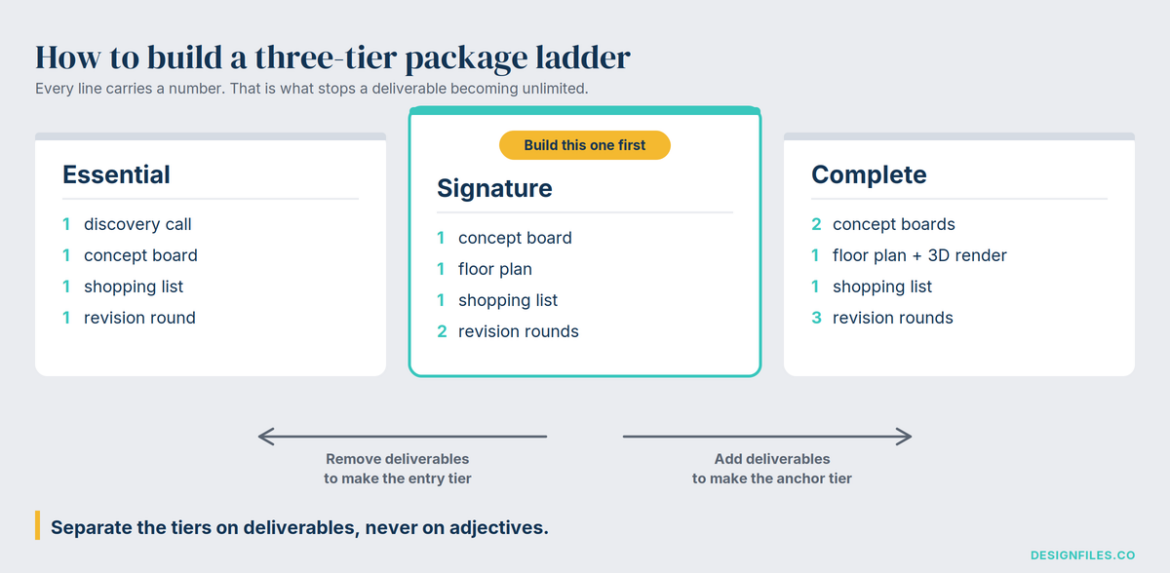
Offer three. Two forces a yes or no decision. Four creates paralysis. Three gives her a choice without giving her a research project.
Build the middle one to sell. Buyers avoid the cheapest option and few reach for the most expensive. Your middle tier should be the package you most want to sell, and the other two partly exist to make it look right.
Price the top tier honestly. It does real work even when it rarely sells, because it makes the middle one look reasonable. But price it as something a client could genuinely buy. A top tier nobody could ever justify reads as a trick, and prospects are better at spotting that than we give them credit for.
Separate the tiers on deliverables, not adjectives. More rooms, more revisions, a 3D render instead of a flat board. Not “priority support” or “enhanced attention,” which she has no way to evaluate.
Here is the practical instruction. Build the middle tier first. Then remove deliverables from it to make the entry tier, and add to it to make the anchor.
I have watched designers build the cheap one first and then struggle to justify anything above it. Starting in the middle solves that, because you are describing the package you actually want to sell rather than defending upgrades to a bare minimum.
The free package builder does this arithmetic for you. List your deliverables and the hours each one takes, set how many go in each tier, and it returns three prices. It also shows what your effective rate becomes if a package runs 25 percent over, which is the number worth checking before you publish anything.
7 real interior design package examples
These are live packages from working designers, published on DesignFiles. You can open every one of them.
That matters more than it sounds. Most articles on this topic show you mockups or their own marketing. These are real offers that real designers are selling right now, with their own pricing and their own deliverables.
As you go through them, look at three things. How specific the deliverable list is. Whether the price is visible without a call. And whether you could tell, in ten seconds, who each package is for.
I have flagged what each one does well and, where it applies, what I would change.
1. Virtual Paint Consultation
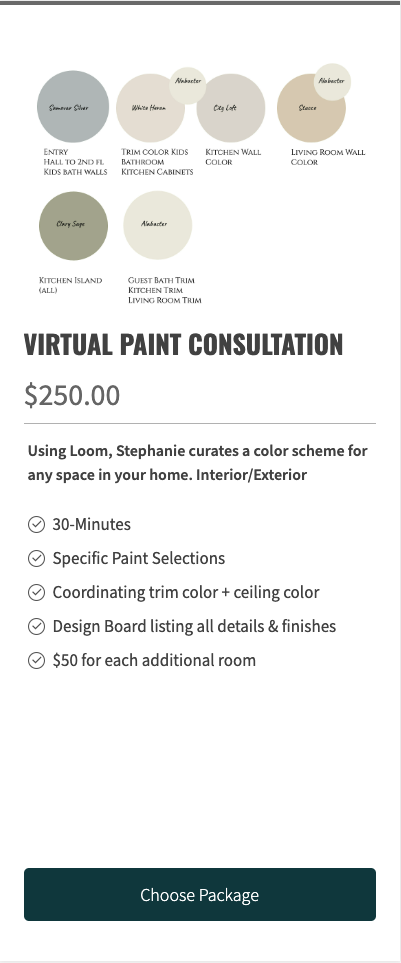
This Virtual Paint Consultation by The Right Space is a small service turned into a clean, complete package.
Not everyone needs a full renovation, and offering something smaller distinguishes your brand while attracting clients who are not ready for more.
What works: the combination of strong visuals, the detail about how the consult is delivered (via Loom), and bullet points covering every service, deliverable and the price.
2. Elemental Design Package
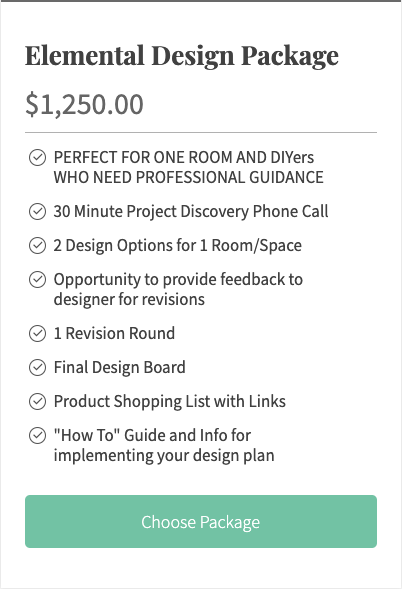
The Elemental Design Package by Laurel Alexander Interiors stands out for its name, its visible pricing, and its clarity about audience.
The first bullet states who the package is for. That single line filters out the wrong clients and attracts the right ones before anyone books a call.
It is also precise down to “1 revision round.” No room for misinterpretation, which is exactly the specificity this whole guide argues for.
3. Bookshelf Styling
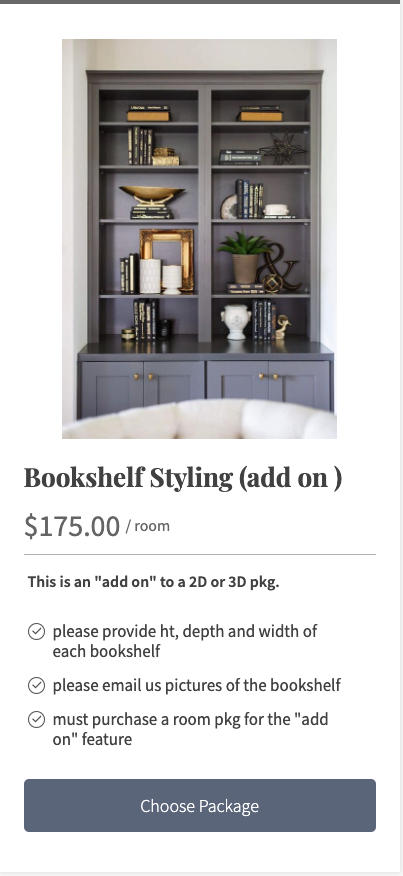
This Bookshelf Styling package by Van Wicklen Design & Co is a smart idea. An add-on service like this raises the value of a larger project and genuinely helps the client, because a bookshelf is only as good as its styling.
What I would change: add a deliverables bullet. Will she receive shoppable links for new items, or suggestions using what she already owns? How many revision rounds? Answering those would make a good package a great one.
4. The POSH DIB and the LUXE DIB
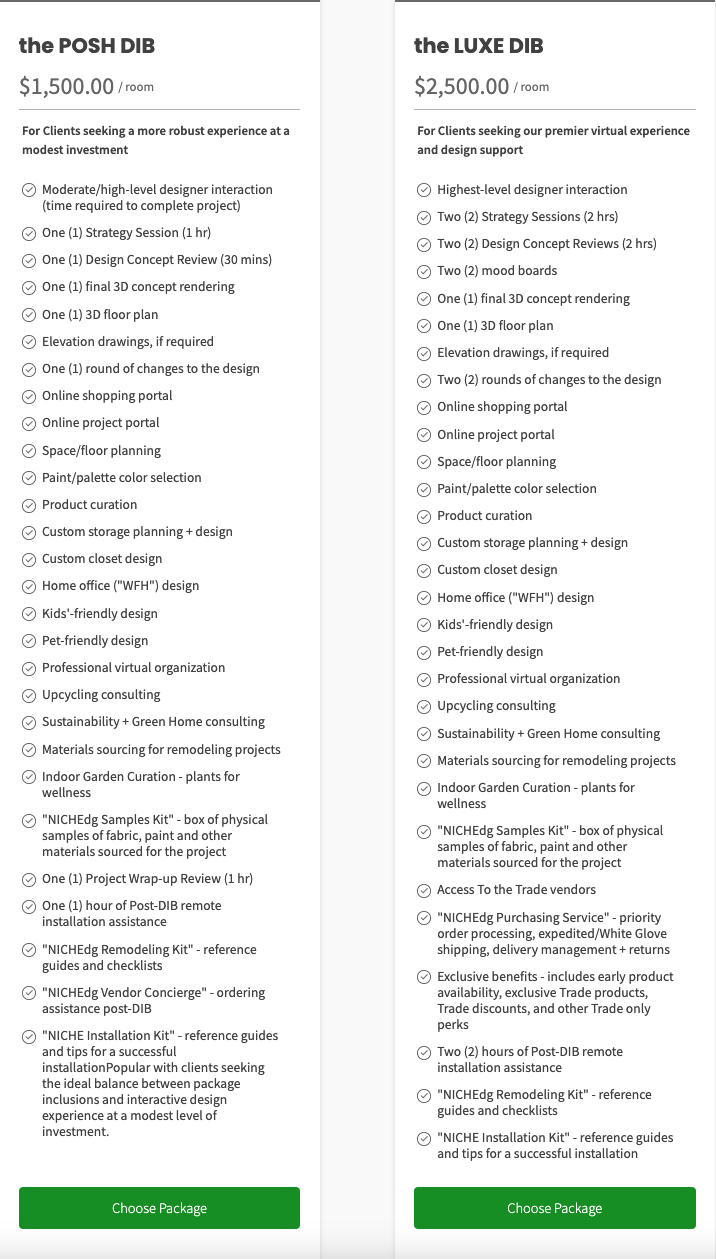
The Posh DIB and Luxe DIB packages by NICHEdg show tiering done well. Both are comprehensive, and the Luxe adds services and perks for clients wanting an elevated experience.
The layout is the lesson here. Placing them side by side lets a prospect compare pricing, services and deliverables in one view and choose for herself.
5. Virtual Design Package
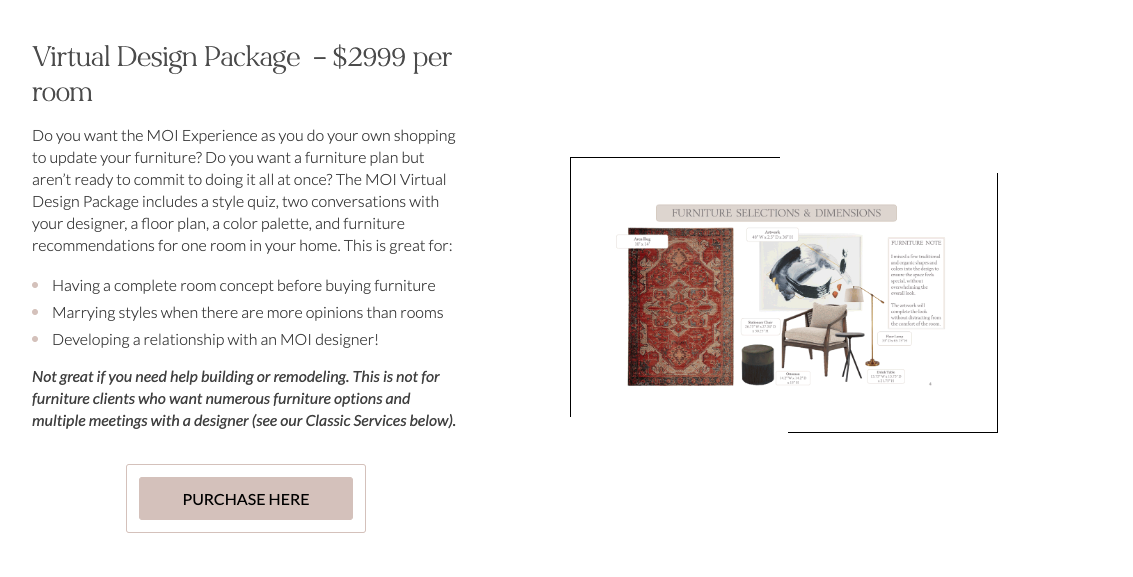
This Virtual Design Package by Martha O’Hara Interiors is lighter on deliverables, but the description keeps options open so clients can shape it to their needs.
It also states clearly who the package suits and who it does not, which is rarer than it should be. Pricing is clear, and the visuals show prospects what they will actually receive.
6. Designer on Demand
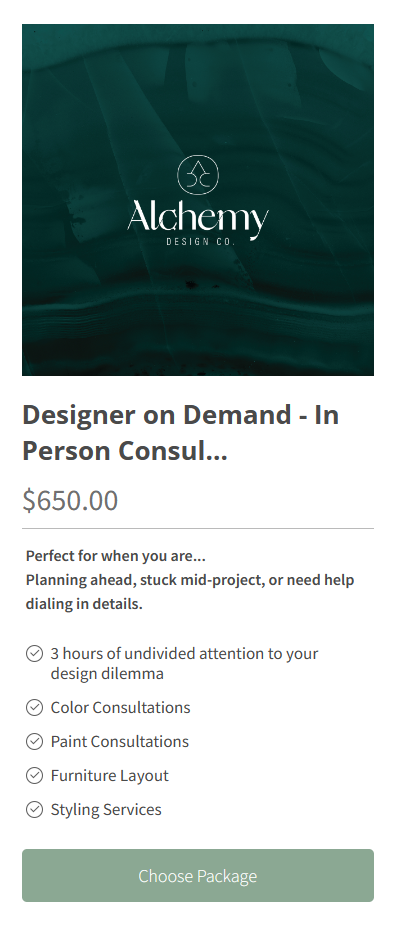
Many designers now offer “designer for a day” services to reach an audience that cannot afford a fully managed project.
The Designer on Demand offering from Alchemy Design Co suits clients planning ahead, stuck mid-project, or needing help with details. It covers colour consultations, furniture layout and styling selections.
The flexibility is the feature. One package, several use cases, all defined.
7. 3 Rooms Design Standard
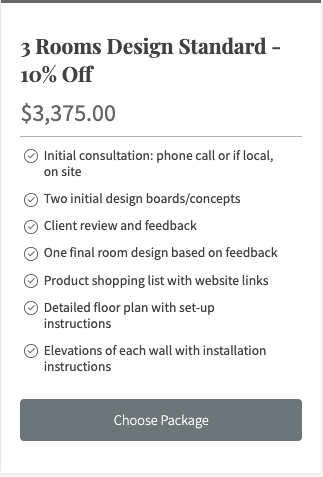
The 3 Rooms Design Standard by Mathieson Design puts a discount in the package title, which draws attention and signals value immediately.
The name is simple and transparent, with no ambiguity about what is included.
Two tweaks I would make. Specify whether it is two design boards total or two per room. And define the number of revision rounds, or the client will assume there is no limit.
Want more than seven? Browse hundreds of live designer packages built on DesignFiles. It is the fastest way to see how designers in your niche are structuring and pricing their offers.
Where to put your packages so people actually buy them
Building the package is half the job. Nobody buys what they cannot find.
A dedicated services or packages page on your site. Most designers skip this and bury pricing inside a general services paragraph. Give packages their own page and let people compare tiers.
The link in your Instagram bio. Most solo designers get their leads there. Sending that traffic to a homepage wastes the click.
Inside your proposal. Present tiers rather than one number. A client choosing between three options behaves very differently from a client deciding yes or no on one. Our guide to interior design proposals covers the document itself.
A shareable package link. Something you can send directly in a DM or an email, that looks professional and lets her buy without a call.
A designer in one of my workshops had three tiers and her top one had not sold once in a year. She was ready to cut it. Then she looked back at her numbers and saw her middle tier bookings had roughly doubled since she added it. The top tier was never meant to sell. It was making the middle one look reasonable, and it was working.
Start with the middle tier
The price is the easy half. What decides whether a package earns is how precisely you defined it.
So do this first. Write your middle tier, and list every deliverable with a number attached. Not “moodboards” but two. Not “revisions” but two rounds, with a price for the third.
Once that one is right, the other two build themselves.
For the full system, including how to structure profitable packages from the ground up, download our Ultimate Profitable Packages Guide.
Then give your packages somewhere to live. DesignFiles lets you build and publish design packages clients can view and buy from a single link, with quotes and invoices connected to the same project. Start free, no credit card required.
Interior design package FAQs
Every service and deliverable the client receives, each with a quantity attached. A typical e-design package includes a consultation call, a concept board, a floor plan, a shoppable product list, a set number of revision rounds, and a follow-up. Add a timeline, the price, and what happens if she wants more revisions. Vague deliverables are the main reason packages lose money.
Consultation and mini packages commonly run $300 to $1,000. Design-only e-design work runs roughly $450 to $1,500 per room, while full-service per-room figures including furnishings run much higher. Treat those as reference points rather than targets. Your number should come from your own hourly rate multiplied by the hours the package genuinely takes, plus a buffer.
Three. Two forces a straight yes or no, and four creates decision paralysis. Build the middle tier first, since that is the one designed to sell, then remove deliverables to create the entry tier and add to create the anchor. Separate the tiers on concrete deliverables like rooms, revisions or renders, never on vague promises about attention or priority.
Two rounds is standard for e-design work. What matters more than the number is defining what counts as a revision, because swapping one product and rebuilding a concept are very different requests. State the limit on the package page itself, not just in the contract, and give a price for additional rounds so the boundary is clear before work starts.
Yes, in almost every case. Public pricing means the people who book already know what they cost. That removes sticker shock, and it stops you writing long proposals for prospects who were never going to say yes. It also makes the first call better, because you spend it discussing her project rather than defending a number she is seeing for the first time.

![How Much to Charge for Interior Design [With Free Calculator]](https://blog.designfiles.co/wp-content/uploads/2024/08/charge-for-interior-desig-services-image-16x9-1-768x432.jpg)