
A lead asks what you charge. There is a pause before you answer.
You know that pause. It lasts half a second and feels like a week. Sometimes you fill it with a number you regret. Sometimes you fill it with a question, so you do not have to answer yet.
That pause is not a confidence problem. It happens because you have never derived the number. There is nothing solid to reach for.
Deriving it takes about ten minutes and some honesty about your costs.
The question I get most in workshops is not which pricing model to use. It is some version of am I allowed to charge this much.
This guide covers what to charge for consultations and how to calculate your hourly rate from your own expenses. Then what changes as you gain experience, and how to raise your rates without losing the clients you want. There is a free calculator that does the arithmetic for you.
Published rates for interior designers run from roughly $100 to $500 an hour, depending on market and experience.
That is a very wide range, and it is meant to be. Where you land inside it comes down to your costs, your market, and what you actually deliver.
If what you need is the structure rather than the number, interior design pricing models compared walks through all eight.
Table of Contents
What interior designers are actually charging
Before the arithmetic, some orientation.
Treat every figure below as a reference point. It tells you whether you are wildly out of step with the market. That is all it tells you. Your own costs decide the rest, which is what the next section handles.
Three things move these numbers more than anything else. Where you are. How long you have been doing this. Whether you deliver design only or full service.
So a designer in a smaller market who sits below a coastal figure has not failed at anything.
One more caution before you compare yourself to anything. Almost all published pricing data is collected from the buyer’s side, because homeowners are who the aggregators survey. It describes what people paid, which skews toward larger markets and full service work.
What designers charge for consultations
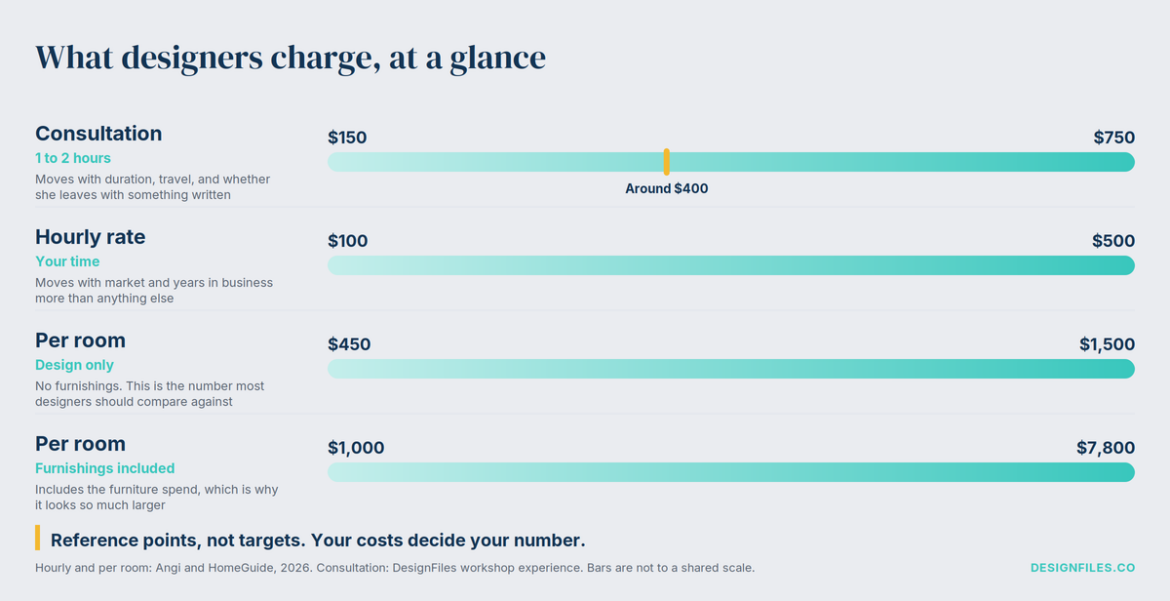
Across the designers I work with, paid consultations usually land between $150 and $750. Most sit near $400 for up to two hours.
The spread is wide because a consultation is not one thing. A ninety minute walkthrough with verbal advice sits at one end. A two hour session that ends with a written summary and a shopping list sits at the other.
Free discovery calls are a separate category, and they are common. More on the difference below, because designers lose money by mixing the two up.
What designers charge per hour
Published hourly rates span $100 to $500, with the higher end concentrated in major cities and among designers with long track records.
If that top figure feels absurd, remember what it reflects. It is a market difference, and often a service model difference, rather than a verdict on your work.
The number that matters is not the published range anyway. It is the rate your own business requires, which almost nobody calculates. We get to that shortly.
What designers charge per room or per project
Per room figures run from roughly $1,000 to $7,800 when furnishings are included, and $450 to $1,500 for design work only.
Look at how far apart those two ranges sit. That gap is the reason so many designers decide they are underpriced when they are not.
Before you compare your fee to anyone else’s, establish which one they are quoting. Design only and full service are different products at different prices.
How to charge for an interior design consultation
The consultation is the first fee your client ever pays you. It teaches her what your thinking is worth.
Give it away and you have taught her that your thinking is free. That lesson is remarkably hard to un-teach three weeks later, when you send a proposal with a number on it.
What genuinely varies is your business model, your experience, and whether the session produces something the client keeps. Here are the three formats worth knowing, and what each one is actually for.
If your consultations double as lead generation, pair this with our guide to getting more interior design clients.
Free discovery calls and what they are actually for
Thirty minutes or less. The purpose is qualification, not advice.
Call it a discovery call, because that is what it is. Plenty of designers call these consultations and then wonder why the conversation goes sideways.
You are finding out what she wants, what she has to spend, and whether the two of you will enjoy each other for six months. She is finding out whether you sound like someone who can help.
Resist the urge to solve anything. The moment you start diagnosing her layout, you have delivered a paid service for free. You have also removed her reason to book one.
End the call the same way every time. Thank her, tell her what you will send, and follow up with a proposal.
Paid consultations and what to charge for them
One to two hours, and this is the session where you actually give advice.
You are offering insight, opinion, and direction shaped around her specific space. That deserves payment. Charging also does something useful beyond the money, because it filters out anyone who was never going to hire you.
Four things move your number. How long the session runs. Whether you travel. Whether she receives a written summary or shopping list afterwards. And your market.
A flat fee keeps this clean for both of you. Collect payment before the session, not after.
Then there is the question every designer asks and no article answers. Should the consultation fee be credited against the project if she books?
Both answers are defensible. Crediting it lowers the barrier and turns the consultation into a sales tool, which suits you if your pipeline is thin. Not crediting it treats the consultation as a standalone service with its own value. That suits you if your calendar is full and the fee is doing filtering work.
Pick based on which constraint you actually have right now.
Paint and specialty consultations
One decision, one session. Usually colour.
These are high expertise and low time, which is a lovely margin profile once you stop treating them as favours. A client who needs the right white for a north-facing room is buying twenty years of your eye. She is not buying ninety minutes of your calendar.
Set the scope and the duration upfront, in writing. Left undefined, a paint consultation expands into a full-service opinion by minute forty.
Which consultation format fits your business
Three options on the table is not an answer. Here is how to pick.
If your projects are large and few, you can afford a free discovery call. One conversion pays for a lot of unpaid conversations.
If you sell e-design or single-room work, you cannot. The consultation is a meaningful share of the whole engagement, and giving it away gives away the margin.
If you have more leads than capacity, charge specifically to reduce volume. That is the fee doing its second job.
So the rule is simple. Charge when your calendar is the constraint. Give it away when your pipeline is.
How to calculate your interior design hourly rate
Here is the part almost nobody does.
Start from your own costs rather than from what the designer down the road charges. Then sense-check against the market once, at the end.
The usual order fails for a reason. A rate borrowed from someone else’s business assumes her cost base, her billable ratio, and her market. The odds of all three matching yours are poor.
A designer in one of my workshops had been at the same hourly rate for four years. We totalled her real costs. The software, the insurance, her accountant, the unbillable admin. Then we added the salary she wanted to pay herself. Her break-even sat above the rate she was charging. She had been paying for the privilege of working. She raised her rate for new clients only, and not one of them asked about it.
The arithmetic, step by step
Four steps. You can do this on paper, though the calculator further down does it for you.
Step one. Total your annual business costs. Be exhaustive. Software and subscriptions, insurance, accounting and legal, marketing and your website, education and memberships, vehicle and travel, workspace, any contractor or assistant help. Designers underestimate this step more than any other. Go through a full year of statements rather than guessing. Our guide to interior design business expenses has the full list.
Step two. Add the salary you want to pay yourself. As a line item, not as whatever is left over in December. If you want $75,000, that is an input.
Step three. Add a profit margin on top. Fifteen percent is a reasonable starting point. A business that only covers its costs and your salary has nothing to absorb a slow quarter.
Step four. Divide by your genuinely billable hours. Not your working hours. The next section explains the difference, and it is bigger than you think.
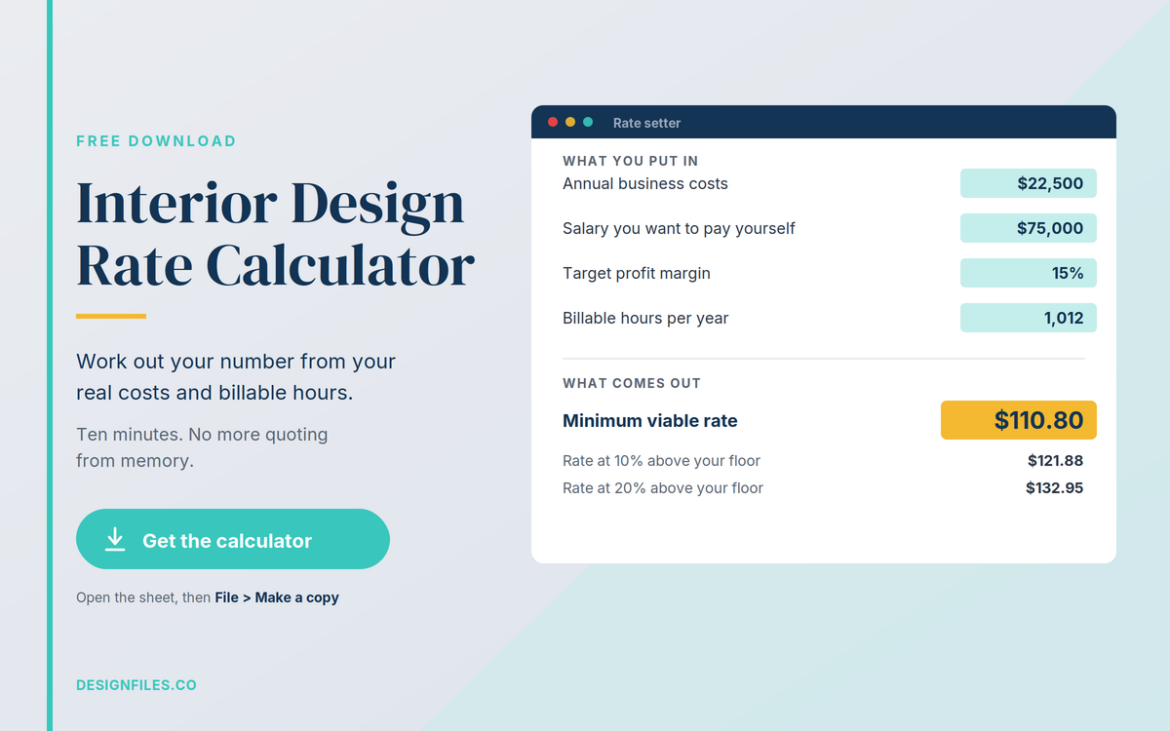
Worked through with round numbers. Take $22,500 of costs, a $75,000 salary, and a 15% margin. You need to bill about $112,000 a year. Spread across 1,012 billable hours, that is roughly $111 an hour. These figures are illustrative, not benchmarks.
Run your own numbers through the calculator if you would rather not do the maths by hand.
The billable hours problem
This is the step that surprises people, so sit with it for a second.
You probably set your rate as though you bill a full working week. Almost nobody does.
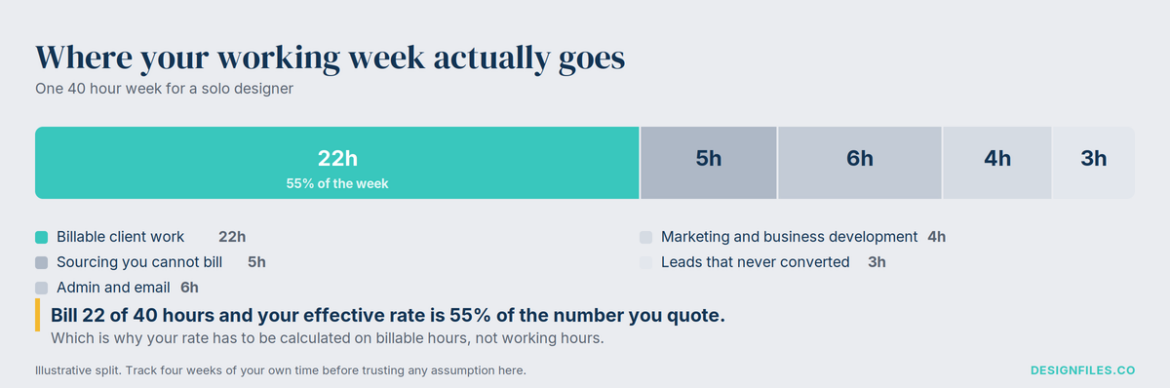
Sourcing you cannot bill. Admin. Email. Marketing. Business development. Every hour spent on a lead who never converts. All of it sits outside billable time.
A designer working forty hours and billing twenty-two has an effective rate roughly half what she thinks she charges.
So do not guess your billable ratio. Track for four weeks and then trust the number, because estimates in this area run consistently optimistic. Tracking time inside the project itself is easier than reconstructing your week on a Friday afternoon.
Sandra Funk makes the same point from the other direction.
“The biggest hesitation with flat fees is will I get the numbers right? Will I undercut myself? You want to propose a flat fee that will allow you to be the best version of yourself as a designer. You want to give the best design to your clients every single time. Track all of your time so you have data on how long it takes you to put a room together.”
Sense-checking your number against the market
Now, and only now, compare your number against the ranges earlier in this article.
Three outcomes, three responses.
If your calculated rate sits inside the published range, you are done. Go and use it.
If it sits above, your cost base may be high for your market. Or you may be positioned for a client you are not yet marketing to, which is a different problem with a better solution.
If it sits below, you have just found money.
Then stop. Adjust once and leave it alone. Recalculating until the number feels comfortable defeats the exercise, and comfort was never a pricing input.
The free interior design rate calculator runs all four steps for you. Enter your costs, your salary, and your billable hours, and it returns your floor plus rates at ten and twenty percent above it. Open it and choose File, then Make a copy.
What to charge at each stage of your business
Underneath the arithmetic sits a different question. Am I allowed to charge this?
Here is roughly how it moves.
| Stage | What justifies your rate | The common mistake | Change this first |
|---|---|---|---|
| First year | Your eye, your training, and the time the work genuinely takes | Starting low to win work | Your floor. Calculate it before you quote anything |
| Years two to four | A portfolio of finished projects and a process that runs | Raising prices for new clients but never for repeat ones | Your repeat client rate |
| Established practice | Predictable outcomes, a team, and demand you have to turn down | Holding a rate that made sense three years ago | Your rate, annually, whether or not it feels urgent |
| Moving upmarket | Work that photographs like the work you want next | Expecting the rate to move before the portfolio does | Your portfolio and your marketing |
Two of those deserve saying plainly.
Starting low to win work is the most expensive decision a new designer makes. Raising a rate is much harder than setting one, and the clients a low rate attracts are rarely the ones who let you raise it later. Nancy Ganzekaufer’s argument for setting a real floor from day one is on our pricing models guide, and it is worth reading before your next proposal.
And moving upmarket almost never starts with the rate. Every time I have watched a designer make that move successfully, the portfolio changed before the client list did. If your work still photographs like the projects you are trying to leave behind, the rate will not hold.
Ready to package all of this into something clients can say yes to? Our Ultimate Profitable Packages Guide walks through it. So does our guide to interior design pricing packages.
Which pricing structure to put your number in
You now have an hourly rate. An hourly rate is only one of the ways to charge it.
Here are the eight structures designers use, one line each.
- Flat fee by room. A set fee per room, calculated from the hours you expect it to take.
- Square footage. A rate per square foot, which scales with size rather than complexity.
- Hourly. Your rate times the hours worked, best where the hours are unpredictable.
- Hybrid. Flat on the design phase, hourly on implementation.
- Cost plus. Your cost on furnishings plus an agreed percentage.
- Percentage of project cost. A percentage of the total spend, construction included.
- Daily fee. A set rate per day, suited to short intensive engagements.
- Retainer. A fixed monthly payment for ongoing availability.
Most designers end up combining two or three. The combination usually decides whether a project is profitable.
Each of these has real tradeoffs, and picking wrong costs you more than pricing slightly low. Interior design pricing models compared covers all eight properly, with a calculator that shows what one of your finished projects would have paid under each.
How to raise your rates without losing the clients you want
The maths is the easy part. This is the part that keeps designers at the same rate for four years.
When to raise. Not on a calendar. Raise when the signals show up. You have not moved in over a year. You have added services. Demand is outstripping your availability. Or you feel resentful about a project you agreed to. Our pricing models guide covers all five signals in detail.
How much in one move. Ten to twenty percent lands without much friction. Larger jumps are sometimes correct, particularly if you have been badly underpriced, but expect to lose some clients at the bottom of your list. That is usually the point.
Who to raise on first. New leads, always. They have no anchor and no comparison. Existing clients come later, at a natural break like a new project or a new year.
What to say. Keep it short and do not apologise. Something like: my rates are increasing to $X from the first of March. I wanted to give you plenty of notice, and I would love to keep working together. Then stop typing. Explanations invite negotiation.
Now the fear underneath all of it. You are worried about losing clients.
Some will go. Here is the reframe that helps: a rate increase that loses a client who was never profitable is a good outcome, not a failure. You have just bought back the hours she was consuming.
I have never once watched a designer lose a client she wanted over a rate increase. I have watched several lose a year of income by not asking.
Earning more without raising your rate
Your rate is not the only lever, and two others are worth knowing.
Product markup earns you a margin on furnishings you source, separately from your design fee. It compensates the sourcing, the vendor relationships, and the order management. Our guide to how to explain markup to clients covers the percentages and the conversations.
Affiliate and commission revenue works when your clients prefer to shop themselves. Instead of losing that spend entirely, you earn on it. Our roundup of interior design affiliate programs covers which ones are worth your time.
Start with the number, not the model
Your rate comes from your costs and your real billable hours. The market is a sense check at the end, not a starting point.
So do the first step today. Open the rate calculator, choose File and Make a copy, and fill in the costs section. Ten minutes, and you will have a number you did not have this morning.
Then track your hours against it, because a rate is a guess until you do. DesignFiles tracks time inside each project and shows what every project actually earned. Start free, no credit card required.
Once the revenue arrives, how to pay yourself covers what to do with it.
Interior design pricing FAQs
It depends on which constraint you have. If your pipeline is thin and your projects are large, a free thirty minute discovery call is a reasonable investment. If your calendar is full or you sell smaller engagements, charge. The fee filters out browsers and pays you for advice you would otherwise give away. Keep free calls short and firmly focused on qualification.
Across the designers I work with, paid consultations usually land between $150 and $750, with most near $400 for up to two hours. Your number moves with duration, travel, market, and whether the client leaves with a written summary or shopping list. Charge a flat fee rather than hourly, and collect payment before the session rather than after.
Track your hours on the projects you have already finished, then quote from that data rather than from memory. Break the work into phases and price each one separately, because unpredictable phases need a different structure than predictable ones. Add a revision limit and a change order trigger in writing. Most underquoting is a scope problem wearing a pricing costume.
Review annually, and raise whenever the signals appear rather than waiting for a date. Ten to twenty percent moves without much friction. Apply it to new leads immediately and to existing clients at a natural break, like a new project or a new year. If you feel resentful about a project you agreed to, you are already overdue.
Not usually. You do the same thinking, hold the same client relationship, and carry the same expertise. A modest discount is defensible if you are not travelling. Your hourly rate itself should not change. Nancy Ganzekaufer makes this argument in full on our pricing models guide, and it is worth reading before you discount anything.
Ready to sell your services, complete projects in less time, and keep clients coming back for more? Checkout DesignFiles, top top-rated all-in-one design platform on Capterra.